

Australian accountant charges for small business range from $1,500 per year for straightforward compliance work to $60,000 or more per year for full advisory and Virtual Chief Financial Officer (VCFO) support. That is a wide spread, and most of the guides you will find online do not help you narrow it down.
The reason? Most content on accountant prices for small business is written for sole traders and micro businesses turning over less than $2M. If you are an SME owner running a business between $500K and $20M, you need more than a tax return, and the pricing conversation looks completely different.
Here are the three main pricing models you will encounter:
| Model | Typical Cost | What’s Included | Best For |
|---|---|---|---|
| Hourly Rates | $150-$400+ per hour | Time-based billing for ad hoc tasks like tax advice or restructures | One-off projects or specialist advice |
| Fixed-Fee Compliance | $1,800-$5,000 per year | Annual tax return, BAS lodgement, financial statements | Simple businesses needing predictable compliance |
| Monthly Retainer | $1,500-$5,000+ per month | Compliance plus monthly reporting, forecasting, strategic advice | Growing SMEs needing advisory support and clarity |
Once your turnover passes the GST registration threshold of $75,000 ($150,000 for non-profits), BAS obligations begin, and your accounting costs step up accordingly. The rest of this article will help you figure out exactly where you sit.
Most content on accountant prices for small business is written for sole traders and micro businesses turning over less than $2M. If you are an SME owner running a business between $500K and $20M, you need more than a tax return, and the pricing conversation looks completely different.
What accountants actually charge small businesses in Australia
When researching accountant fees for small business in Australia, it's important to recognise that pricing models vary widely depending on your business size, structure, and needs. What a microbusiness pays for basic compliance is vastly different from what a $10M SME might invest in strategic advisory support.
Here are the three main pricing models you will encounter:
- Hourly rates: $150 to $250 for mid-level accountants, $250 to $400 or more for senior or partner-level advisors.
- Fixed-fee compliance packages: $1,500 to $5,000 or more per year, covering annual tax returns, Business Activity Statement (BAS) lodgement, and financial statements.
- Monthly advisory retainers: $1,500 to $5,000 or more per month for compliance plus strategic support, including reporting, cash flow forecasting, and decision-making support. VCFO-level engagements start at $5,000 per month.
Once your turnover passes the GST registration threshold of $75,000 ($150,000 for non-profits), BAS obligations begin, and your accounting costs step up accordingly. The rest of this article will help you figure out exactly where you sit.
What drives the cost up or down
The gap between a $2,000 annual fee and a $5,000 monthly retainer is not arbitrary. It reflects genuine differences in scope and complexity.
Entity structure is the single biggest driver. A sole trader with one ABN is a fundamentally different engagement from a group structure with three entities, intercompany transactions, and consolidated reporting. Each additional entity adds ASIC annual review fees, separate tax return lodgements, and compliance obligations that compound the workload.
BAS frequency matters more than most owners realise. Most SMEs lodge quarterly, but businesses with a turnover of $20M or more are required to lodge monthly. That alone can double the compliance component of your fees.
Payroll size and obligations quickly scale costs. As your wage bill grows past $1M, state-based payroll tax thresholds come into play, each with different rates and registration requirements. Add Fringe Benefits Tax (FBT) reporting for employee benefits, and the compliance layer thickens again.
Then there is the distinction that matters most: compliance-led versus advisory-led engagement. A compliance-led firm prices on tasks completed. An advisory-led firm prices on the scope of the relationship and the strategic value delivered. Same profession, very different commercial model. Accounting firms in Sydney and Melbourne typically charge 10-20% more than regional firms for comparable services.
It's also important to clarify that bookkeeping is usually a separate service from accounting. Bookkeeping costs typically range from $500 to $2,000 per month, depending on transaction volume and complexity. Unless included in a broader monthly retainer, the pricing discussed here assumes bookkeeping is handled separately.
Three pricing models and what each one actually gets you
While common, hourly pricing is the least predictable of all accountant rates small business owners might encounter. Mid-level advisors typically bill $150-$250 per hour, with senior advisors charging more.
Hourly rates are the most common model and the least predictable. You pay for time, which means the firm is incentivised to spend more of it. This works for one-off projects, such as a tax restructuring or a specific piece of advice. It does not work well as the foundation of an ongoing relationship because costs are reactive and hard to forecast.
Fixed-fee compliance packages solve the predictability problem for defined deliverables. A typical package, priced at $1,800 to $5,000 per year, covers your annual tax return, BAS lodgement, and preparation of financial statements. The scope is locked, which means that strategic questions, ad hoc advice, or anything outside the agreed deliverables will either be billed separately or not addressed at all.
Monthly advisory retainers cover compliance plus ongoing strategic support. A retainer of $3,000 per month typically includes monthly Profit and Loss (P&L) reporting, regular strategic meetings, cash flow forecasting, and access to the team for day-to-day decision support. This is what business advisory accounting actually involves: a thinking partner who understands your numbers as well as you do and helps you act on them.
The comparison is straightforward. A $1,800-per-year compliance package gets your tax return and BAS done. A $3,000-per-month retainer provides financial clarity, forward-looking reporting, and a strategic partner embedded in your business. The right choice depends entirely on what your business needs right now.
Signs you have outgrown your current accountant
This transition point typically hits between $2M and $10M in turnover. The compliance-only model that worked at $500K starts to cost you in missed opportunities and reactive decision-making. Here is what that looks like in practice:
- You only hear from your accountant at tax time.
- You are making major financial decisions without their input.
- Your reporting is always backward-looking and never forward-looking.
- You have multiple entities but no consolidated view of performance.
- Revenue is growing, but cash flow feels unpredictable.
- You need CFO-level thinking, but cannot justify a full-time hire.
That last point is where Virtual CFO (VCFO) support becomes relevant. It provides strategic financial leadership on a fractional basis at a fraction of the cost of a full-time $250,000-per-year CFO.
This is not a criticism of your current accountant. Some firms are built for compliance. Others are built for advisory. The question is which one matches where your business is heading, not where it has been.
How Parkview approaches pricing
Parkview operates on a monthly retainer model because it aligns incentives. The firm benefits when the business grows. Costs are predictable for the client. And the relationship is proactive rather than reactive.
A typical engagement includes:
- A full finance function operating as an extension of your business.
- Monthly reporting with regular strategic meetings.
- Availability for day-to-day decision support.
- Advisory-led thinking rather than compliance-led box-ticking.
You can see more details on our business advisory approach.
This model is not for everyone. If your business only needs an annual tax return and quarterly BAS, a fixed-fee compliance package from a good local firm is perfectly reasonable. Parkview's model is built for SME owners who want a strategic partner, not just a service provider.
Talk to our team about what the right level of support looks like for your business.
How to figure out what you actually need
The real question isn't just the cost of an accountant for a small business, but whether you're getting the right financial capability for your business stage. Match the support level to your strategic needs, and the investment pays for itself.
Before you request a quote or even search how much do accountants charge for small business, it helps to understand what level of support your business truly needs. Answer these six questions:
- What is your annual turnover?
- How many entities do you operate?
- Do you lodge BAS monthly or quarterly?
- How many employees are on payroll?
- Do you need reporting and forecasting, or just compliance?
- Do you want someone available between tax time?
Your answers map to indicative pricing tiers:
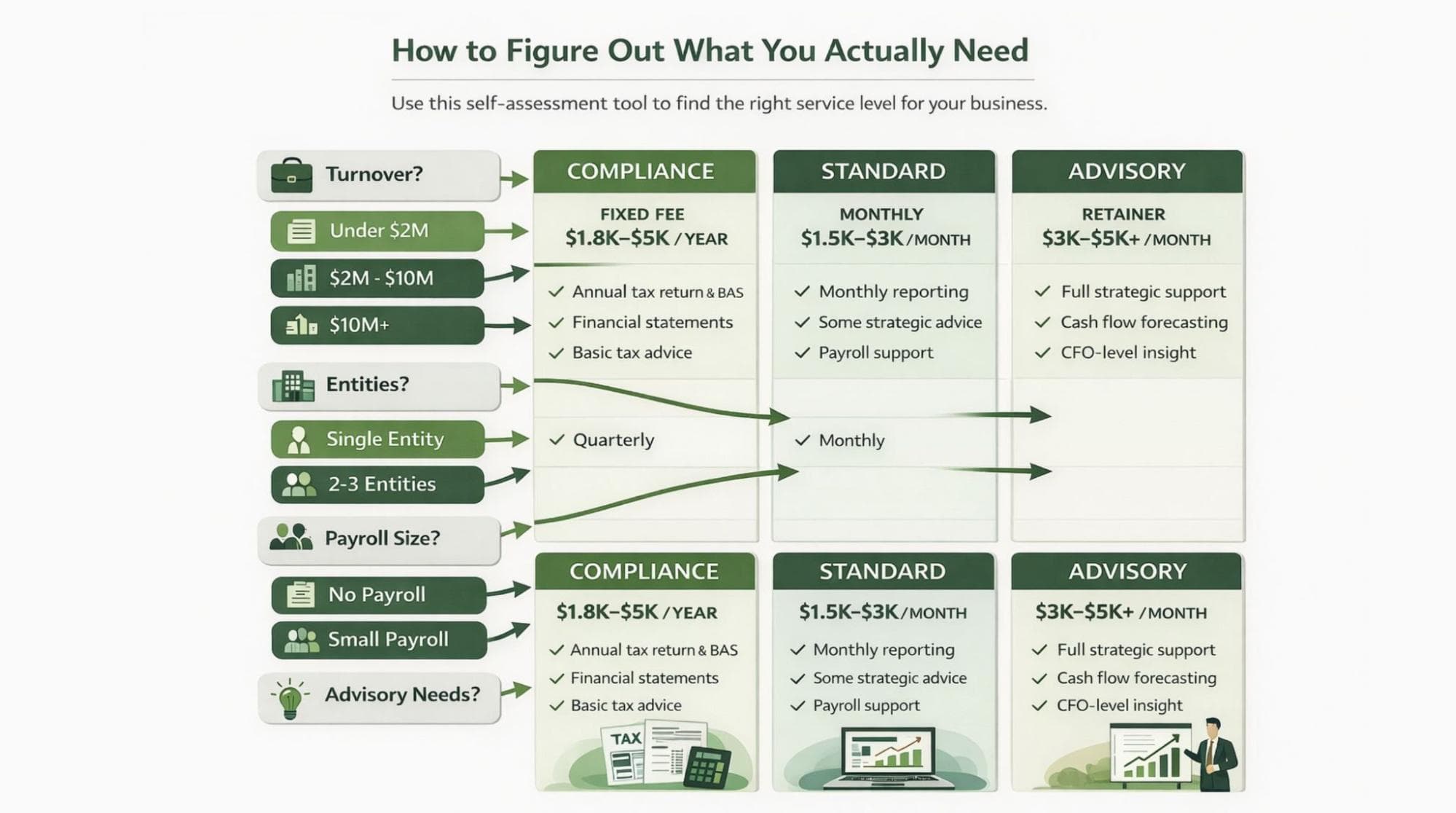
- Single entity under $2M, quarterly BAS, compliance needs only: $2,000 to $5,000 per year as a fixed fee. Look for a firm that offers clear fixed-fee compliance packages with defined deliverables. Ask exactly what is included and what gets billed separately.
- Multi-entity business, $2M to $10M, payroll, some advisory needs: $2,000 to $4,000 per month on a retainer. At this level, you need monthly reporting, proactive tax planning, and a team that understands your group structure. Ask prospective firms how they handle intercompany transactions and consolidated reporting.
- Complex group structure, $5M to $20M or more, VCFO-level support: $5,000 to $10,000 or more per month. This is a full finance function: monthly reporting, strategic meetings, cash flow forecasting, board-ready financials, and a senior advisor embedded in your decision-making. Evaluate firms on the depth of their advisory capability, not just their compliance credentials.
Here's a side-by-side comparison of what different business types should expect to pay—and what to look for in an advisory partner:
| Business Profile | Indicative Cost | What to Expect | What to Ask |
|---|---|---|---|
| Single Entity Under $2M Quarterly BAS, minimal payroll, and compliance needs only | $2,000-$5,000/year (fixed fee) | Annual tax return, BAS lodgement, and financial statements. Strategic advice is billed separately or excluded. | What’s included in the fixed fee? What triggers extra charges? Are BAS and ASIC fees included? |
| Multi-Entity $2M-$10M Payroll, intercompany transactions, and some advisory needs | $2,000-$4,000/month (retainer) | Monthly reporting, tax planning, consolidated financials, and access to advisors for ongoing questions. | How are intercompany transactions handled? Is reporting consolidated? What level of strategic input is included? |
| Complex Group $5M-$20M+ High payroll, multiple entities, VCFO-level advisory needs | $5,000-$10,000+/month (retainer) | Full finance function with strategic oversight, board-ready reporting, cash flow forecasting, and CFO-level support. | Who leads the engagement? How deep is their advisory experience? Are meetings and forecasting included by default? |
The real question is not how much an accountant costs for a small business. It is what the right level of financial support looks like for your business's direction. Get that answer right, and the cost conversation takes care of itself.
Alex
Helping Australian SMEs understand the true cost of financial support and find the right advisory model for their stage of growth.