

Here are the dates you came for. A Business Activity Statement (BAS) is the form Australian businesses use to report and pay goods and services tax (GST), pay as you go (PAYG) instalments, PAYG withholding, and other tax obligations to the ATO. Below are the quarterly BAS lodgement dates for the next two financial years.
Quarterly BAS due dates
If you are looking for BAS lodgement dates 2026, the table below covers both the 2025-26 and 2026-27 financial years, including standard ATO due dates and BAS agent extensions.
| Quarter | Period covered | Standard due date | BAS agent extended due date |
|---|---|---|---|
| Q1 | Jul - Sep 2025 | 28 October 2025 | 25 November 2025 |
| Q2 | Oct - Dec 2025 | 28 February 2026 | 28 March 2026 |
| Q3 | Jan - Mar 2026 | 28 April 2026 | 25 May 2026 |
| Q4 | Apr - Jun 2026 | 28 July 2026 | 25 August 2026 |
| Q1 | Jul - Sep 2026 | 28 October 2026 | 25 November 2026 |
| Q2 | Oct - Dec 2026 | 28 February 2027 | 28 March 2027 |
| Q3 | Jan - Mar 2027 | 28 April 2027 | 25 May 2027 |
| Q4 | Apr - Jun 2027 | 28 July 2027 | 25 August 2027 |
If a due date falls on a weekend or public holiday, you can lodge and pay on the next business day. Check each date against your state's public holiday calendar, as these vary.
The BAS agent lodgement dates in the right column only apply when your BAS is lodged through a registered BAS agent or tax agent. More on why that matters below.
Monthly BAS due dates
Monthly BAS lodgement is due on the 21st of the month following the taxable period. For example, your July BAS is due by 21 August.
This reporting cadence applies to businesses with a GST turnover of $20 million or more. If your business is scaling and approaching that threshold, it is worth planning for the shift well before you cross it. Moving from quarterly to monthly reporting significantly changes your finance function's workload. The BAS agent lodgement program may also provide extensions for monthly lodgers, so factor that into your planning.
If you are unsure whether your turnover triggers monthly obligations, your GST turnover is your gross business income, not net profit. Rapid revenue growth can push you past $20 million faster than expected.
Annual BAS due dates
Annual BAS is due by 31 October following the end of the financial year. If you are not required to lodge an income tax return, the due date is 28 February.
Annual reporting typically suits smaller businesses with simpler GST obligations. Most businesses turning over $5 million or more will already be on a quarterly or monthly cycle. If you are still lodging annually and your business has grown, it may be time to reassess your reporting frequency.
Why BAS agent lodgement dates give you more time
Lodging through a registered BAS agent or tax agent unlocks extended due dates under the ATO’s BAS agent lodgement program. The extra time is substantial:
- Q1: 28 October moves to 25 November (28 extra days)
- Q2: 28 February moves to 28 March (28 extra days)
- Q3: 28 April moves to 25 May (27 extra days)
- Q4: 28 July moves to 25 August (28 extra days)
That is nearly a full month of additional time each quarter. More time means your BAS is prepared from cleaner, more complete data. It means fewer errors, fewer amendments, and better visibility over your cash position before payment is due.
Many business owners are not aware that this extension exists. It is one of the most practical, tangible benefits of working with a registered agent, and it costs you nothing beyond the relationship you likely already need.
What happens if you lodge your BAS late
The ATO applies two mechanisms to late BAS lodgement.
- Failure to lodge (FTL) penalty: The ATO can issue a penalty for each 28-day period your BAS remains outstanding, up to a maximum based on entity size. For a medium-sized business, this adds up quickly and is entirely avoidable.
- General interest charge (GIC): GIC applies to any unpaid tax debt from the original due date and compounds daily. On a $50,000 GST liability, even a few weeks of GIC becomes a meaningful cost.
For scaling businesses, the real risk goes beyond BAS lodgement fees and penalties. The ATO's compliance approach escalates for businesses that show a pattern of late lodgement. Repeated delays can trigger reviews, audits, and closer scrutiny of your broader tax affairs. One late BAS is a mistake. A pattern of late lodgement is a red flag.
How to lodge your BAS
You have three options:
- ATO Business Portal. Self-lodge directly. No cost, but you carry full responsibility for accuracy, and you receive no extension on due dates.
- ATO online services via myGov. Suitable for sole traders and simpler structures. Same limitations as self-lodging.
- Through a registered BAS agent or tax agent. Your BAS is reviewed by a professional before lodgement. You unlock extended BAS agent lodgement dates, and you have someone accountable if something goes wrong.
The right choice depends on your business complexity. If your BAS involves straightforward GST on a handful of transactions, self-lodging works. If you are managing multiple revenue streams, employee obligations, and PAYG instalments, the risk of errors when self-lodging increases with each quarter.
Common BAS mistakes that trigger ATO attention
The ATO's data matching is sophisticated. It cross-references your BAS against income tax returns, bank data, and third-party reporting. These are the errors that most commonly draw scrutiny:
- Incorrect GST classification. Applying GST to GST-free supplies, or claiming credits on items that are not creditable.
- Claiming GST on BAS-excluded items. Input tax credits on private expenses, entertainment, or exempt supplies.
- Mismatched BAS and income tax figures. If your reported GST turnover does not reconcile with your income tax return, the ATO will notice.
- Failing to reconcile before lodging. Lodging from unreconciled data is the single most common source of BAS errors.
- Inconsistent reporting across quarters. Large swings in GST credits or liabilities from quarter to quarter without a clear commercial reason will trigger a review.
- Unusually large GST credit claims. Significant asset purchases or refund claims are legitimate, but they attract automated scrutiny.
For businesses in the $5 million to $20 million range with complex structures, these errors are more likely and more consequential. Accuracy is not a compliance box to tick. It is risk management.
A quarterly BAS workflow that removes the scramble
The businesses that never stress about BAS lodgement due dates follow a rhythm, not a last-minute sprint. Here is a four-step workflow:
Step 1: Reconcile accounts monthly: Do not wait until quarter end. Monthly reconciliation means your data is clean before BAS preparation even begins.
Step 2: Review GST coding before the quarter closes: Catch misclassifications while the transactions are fresh, not weeks later when context is lost.
Step 3: Prepare your BAS in the first week after quarter end: With reconciled data, this takes hours, not days.
Step 4: Lodge with time to spare: Early preparation means you know your GST liability in advance. No surprises on cash flow. No scramble to find funds.
This workflow turns BAS from a quarterly crisis into a byproduct of good financial management. It also feeds directly into cash flow forecasting. When you know your GST liability weeks before it is due, you make better decisions about when to invest, when to hold, and when to draw.
When BAS becomes a sign that you have outgrown your finance setup
If you are still searching for BAS lodgement dates each quarter and scrambling to pull figures together before the deadline, that is a signal. Not about BAS itself, but about whether your finance function has kept pace with your business.
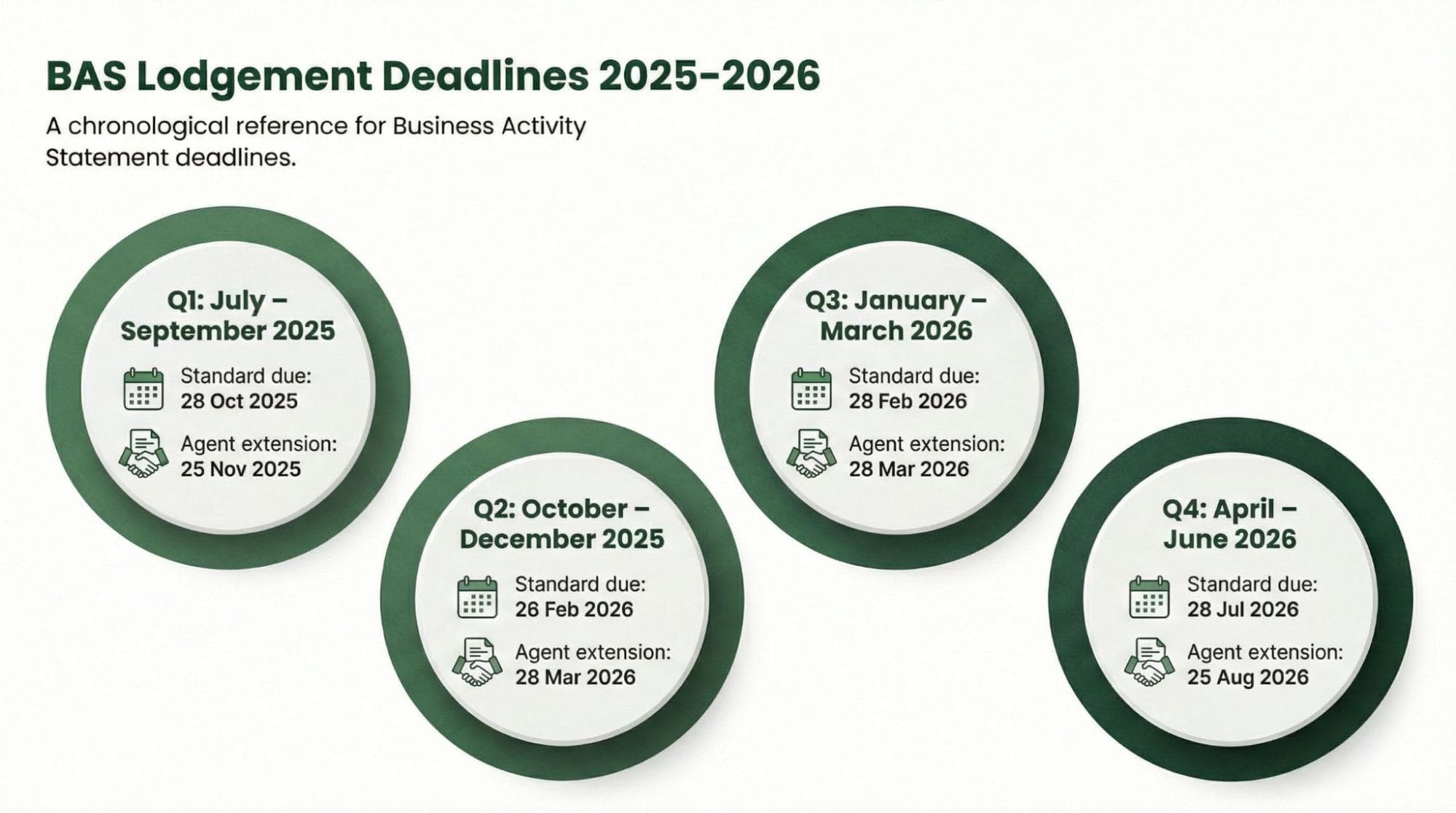
To help visualise these important dates, here is a simple, clear infographic outlining the BAS lodgement deadlines for both standard and agent-extended due dates across each quarter of 2025-2026.
For businesses with annual turnover of $5 million or more, BAS should be a byproduct of a well-maintained finance function. It should not be a standalone task you manage yourself. When your accounting and bookkeeping services are running properly, your books are accurate throughout the quarter, your GST coding is reviewed monthly, and your BAS is prepared and lodged as part of an established rhythm.
The real shift is moving from compliance-led to advisory-led. A full finance function does not just lodge your BAS. It delivers monthly reporting, regular strategic meetings, and day-to-day decision-making support. BAS lodgement becomes effortless when it sits inside something bigger: the financial infrastructure your business actually needs at this stage of growth.
This is not about outsourcing a task. It is about building the capability to stop managing compliance and start using financial data to run your business.
FAQ
What is the penalty for late BAS lodgement?
Answer: If your BAS is lodged late, the ATO may impose a Failure to Lodge (FTL) penalty. This penalty can accumulate every 28 days the BAS remains outstanding, up to a maximum based on your business size. In addition, a General Interest Charge (GIC) applies to any unpaid tax, accruing daily from the original due date.
Can I lodge BAS myself?
Answer: Yes, you can lodge your BAS yourself via the ATO's Business Portal or through myGov if you're a sole trader. However, lodging on your own means you are fully responsible for accuracy, and no extra time is granted for meeting submission deadlines. Errors can lead to penalties.
What is the difference between BAS and IAS?
Answer: A BAS (Business Activity Statement) is used by businesses to report a range of taxes, including GST, PAYG instalments, and PAYG withholding. An IAS (Instalment Activity Statement) is similar, but is used only by businesses that need to report PAYG withholding obligations without GST.
Alex
Helping Australian SMEs stay on top of compliance obligations while building the financial infrastructure needed to scale with confidence.