

When Gut Feel Stops Being Enough
You're turning over $8 million. A commercial lease is up for renewal, you're weighing up a second location, and your senior manager just handed in their notice. Three decisions, all landing in the same month, all with significant financial implications. It's exactly the kind of moment that makes a virtual CFO worth considering, when the numbers exist, but the insight to act on them doesn't.
You open your accounting software. The numbers are there, but they don't tell you what to do next. Your accountant lodges your tax returns on time and keeps you compliant. That's valuable. But they're not the person you call when you need to model the cost of a new hire against projected revenue, or stress-test your cash position before signing a five-year lease.
This is the gap a virtual CFO fills. A Virtual Chief Financial Officer (VCFO) provides CFO-level strategic finance support without the full-time cost. In Australia, an in-house CFO typically earns $180,000 to $250,000 or more, plus superannuation and benefits. For businesses with a $5 million to $20 million turnover, that's rarely justifiable. But the need for that level of thinking is real.
What a Virtual CFO Actually Does
What is a Virtual CFO?
A Virtual Chief Financial Officer (VCFO) provides CFO-level strategic finance support without the full-time cost, offering essential decision-making insights and guidance to businesses that don't need a permanent CFO on staff.
The title can sound abstract, so let's make it concrete. A VCFO doesn't replace your accountant or bookkeeper. They sit above the compliance layer, turning your financial data into decision-making support.
While a business advisory accountant primarily focuses on compliance, tax reporting, and strategic financial advice, a Virtual CFO goes further by providing ongoing, hands-on financial leadership and decision-making support. Virtual CFOs are deeply embedded in your business strategy, helping with scenario modelling, cash flow forecasting, and KPI tracking, all aimed at driving long-term growth. They serve as a financial partner, not just a consultant.
Here's what a typical month looks like in practice.
In the first week, your VCFO reviews your updated cash flow forecast and flags that a large receivable is trending late. They adjust the forecast and recommend a short-term action. In week two, they prepare monthly management reporting: a Profit and Loss (P&L) statement, balance sheet, and cash flow summary, formatted for you and your leadership team, not for the ATO. Week three might involve scenario modelling. You're considering a capital expenditure decision, so your VCFO develops three scenarios that show the impact on cash, margin, and breakeven. In week four, they join your monthly strategic meeting, walking through the numbers and helping you pressure-test your next quarter's plan.
The tangible deliverables typically include:
- Monthly management reporting with commentary
- Cash flow forecasting (the practice of projecting future cash inflows and outflows to anticipate shortfalls or surpluses)
- Annual budgets and quarterly reforecasts
- KPI dashboards tailored to your business
- Strategic planning input and scenario modelling
- Support on funding, investment, or acquisition decisions
Most VCFO engagements run on a monthly retainer with a set meeting cadence, either fortnightly or monthly. Between meetings, your VCFO is available for day-to-day decision support. They're not a consultant who drops in once a quarter. They become a working part of your finance function.
If you're unsure where your current accountant fits, here's a closer look at what a business advisory accountant does and how that role differs from a VCFO.
Who a Virtual CFO Is Right For (and Who It's Not)
A virtual CFO for small business isn't a universal solution. It fits a specific stage of growth and complexity.
The ideal profile: SME owners running businesses in the $2 million to $50 million turnover range, with a sweet spot between $5 million and $20 million. These are businesses where complexity is increasing, whether through headcount, multiple revenue streams, or structural changes, but a full-time CFO isn't warranted.
The clearest signal is what we'd call the “outgrown your accountant” moment. You're asking questions your accountant can't answer. Your reporting is backward-looking, telling you what happened last quarter but not what's likely to happen next. You're making significant decisions based on gut feel because the financial data isn't structured to support planning.
A VCFO is probably not the right fit if:
- Your turnover is between $500,000 and $2 million, and your primary needs are compliance, bookkeeping, and Business Activity Statement (BAS) lodgement. In that case, a strong bookkeeper paired with a business advisory accountant will serve you better.
- Your business exceeds $50 million in revenue, and you need a dedicated, full-time CFO embedded in daily operations. At that scale, the breadth of a VCFO engagement typically can't match the depth a permanent hire provides.
- Your only requirement is to lodge BAS and year-end tax returns. That's compliance work, and a registered BAS agent or tax accountant is the appropriate provider.
Being honest about fit matters. The wrong engagement wastes money on both sides.
Virtual CFO vs In-House CFO: How They Compare
This is one of the most common questions for scaling SME owners, so let's lay it out clearly. The virtual CFO vs in-house CFO decision comes down to five dimensions.
| Dimension | In-house CFO | Virtual CFO |
|---|---|---|
| Cost | $180K–$250K+ salary, plus 11.5% superannuation, benefits, recruitment, and onboarding | $2,500–$8,000+ per month retainer depending on scope |
| Breadth of experience | Deep knowledge of one business | Breadth across multiple industries and business models |
| Flexibility | Fixed cost regardless of business cycle | Scales with your needs; scope adjusts as the business evolves |
| Availability | Full-time, daily presence | Structured meeting cadence with ad hoc availability between sessions |
| Implementation time | 3–6 months to recruit, onboard, and reach full effectiveness | Typically operational within 30–60 days |
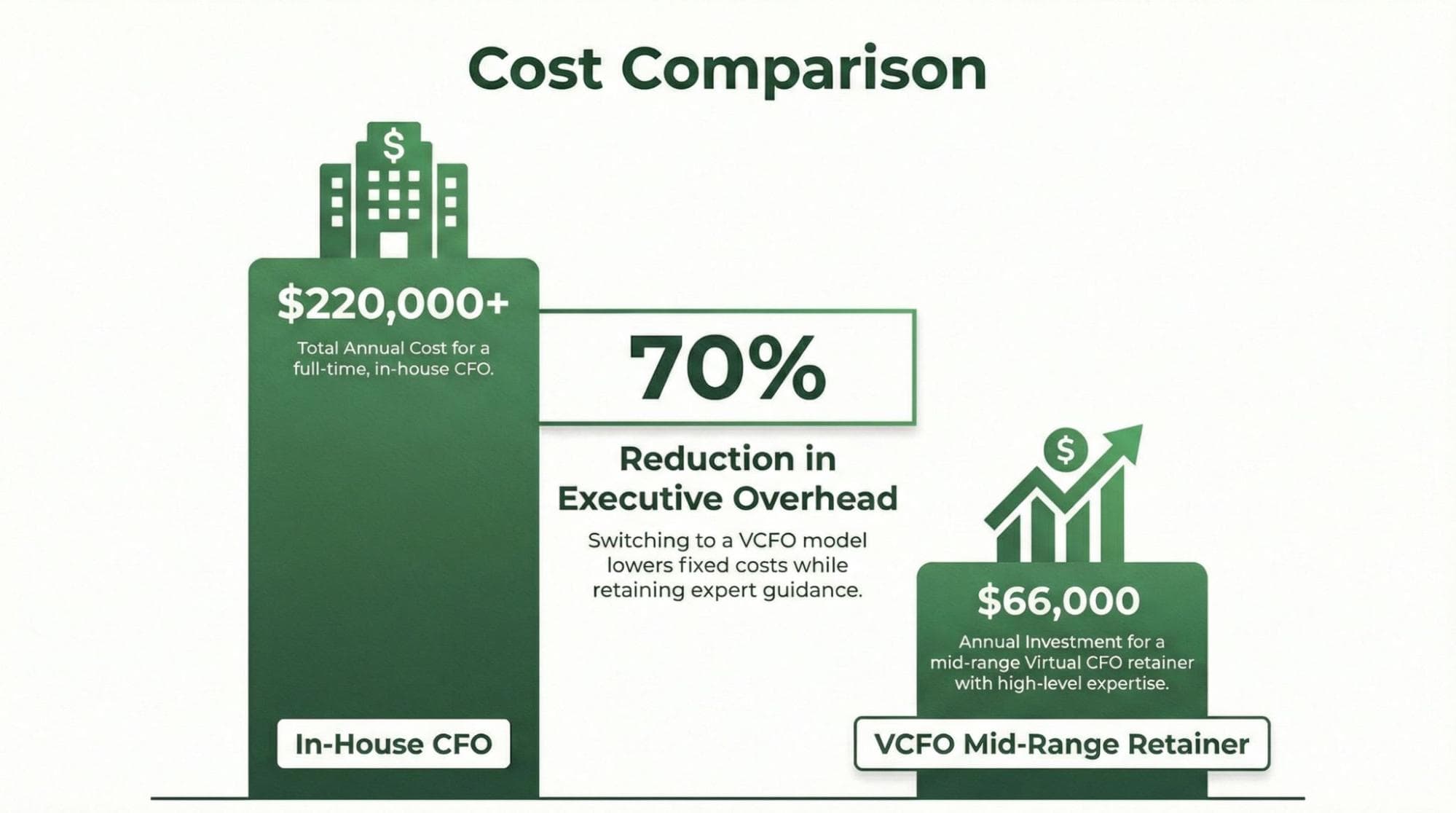
Even at the top end of VCFO pricing, a monthly retainer of $8,000 equates to $96,000 per year. That's less than half the total cost of an in-house CFO once you factor in superannuation, leave entitlements, and recruitment fees.
The VCFO model also brings something an internal hire often can't: pattern recognition across dozens of businesses. A virtual CFO who works with fifteen SMEs has seen your problem before, likely multiple times.
That said, an in-house CFO is the better choice for very large or complex organisations that need a senior finance leader embedded in daily operations, managing a finance team, and present for every decision. If your business requires that level of daily involvement, a VCFO engagement won't be sufficient.
What a Virtual CFO Engagement Looks Like in Practice
One reason SME owners hesitate is uncertainty about how the engagement actually works. Here's what to expect.
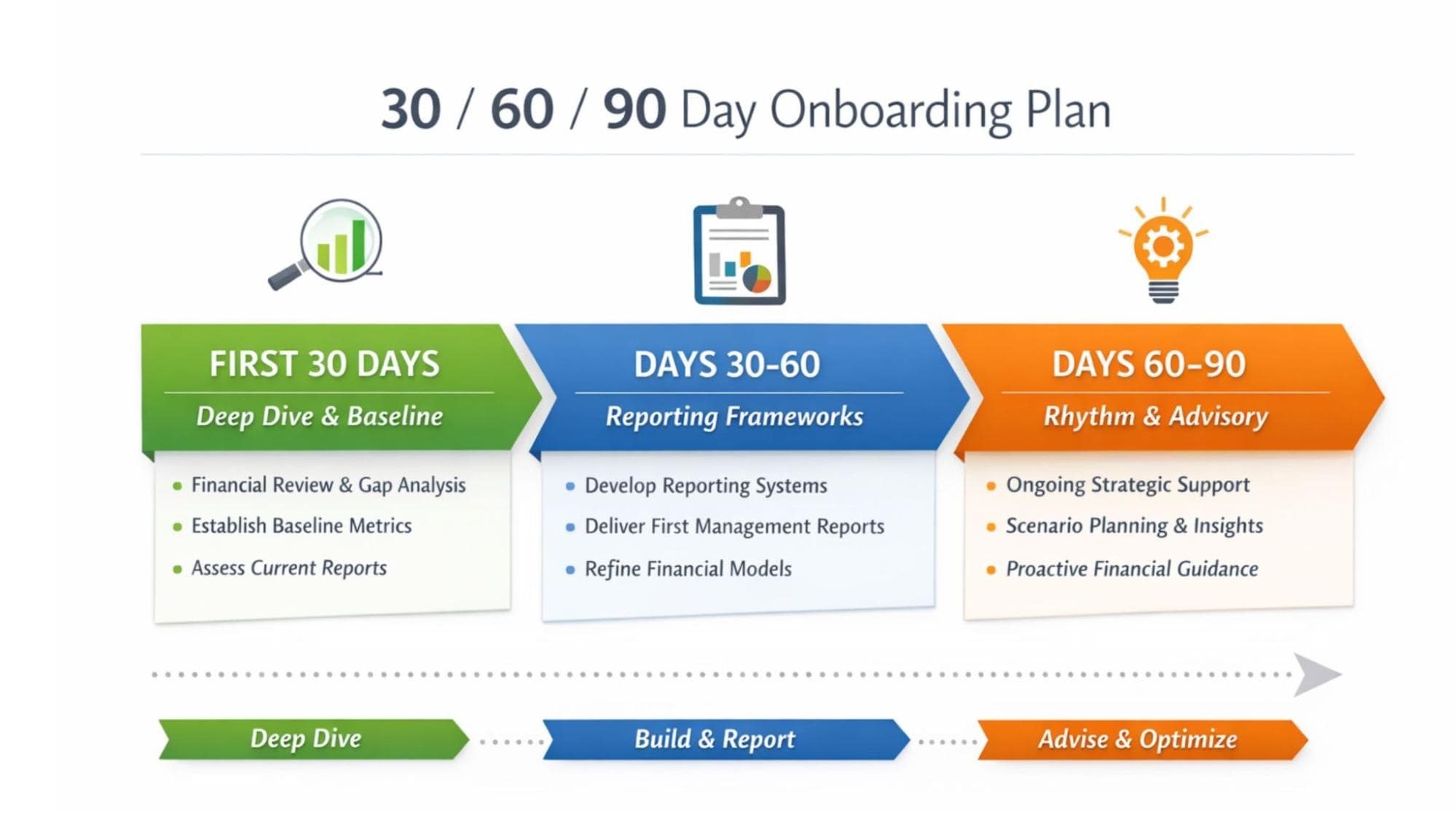
First 30 days: Your VCFO conducts a deep dive into your financial position. They review your chart of accounts, existing reporting, cash flow patterns, debt structure, and business plan. They identify gaps in your current finance function and establish a baseline.
Days 30 to 90: The first two months focus on building reporting frameworks and refining financial models. By the 90-day mark, your VCFO shifts the engagement into a proactive advisory rhythm, regularly assessing and modelling business opportunities.
Between scheduled meetings, your VCFO remains available for day-to-day decision support. A quick call about a supplier negotiation, a review of a contract's financial terms, or a sanity check on a hiring decision. That accessibility is what makes the relationship work. For a closer look at how our virtual CFO service works, including what's included at each engagement level, visit our VCFO services page.
What Does a Virtual CFO Cost in Australia?
Most providers avoid publishing virtual CFO pricing. We think that's a mistake. If you're researching this service, you deserve a straight answer.
Virtual CFO pricing in Australia typically ranges from $2,500 to $8,000 or more per month, depending on the scope and complexity of the engagement.
What drives the variation:
- Number of entities in your business structure (a single Pty Ltd company versus a group with multiple trading entities and a trust)
- Complexity of your reporting requirements
- Meeting cadence: fortnightly versus monthly
- Involvement in strategic projects such as acquisitions, capital raises, or restructures
- Whether the engagement includes oversight of your broader finance function
The most common model is a monthly retainer with agreed scope, reviewed as your business evolves. Project-based or hourly arrangements exist but are less common for ongoing CFO-level work.
For context, an in-house CFO's total employment cost, including salary, superannuation at 11.5%, leave loading, and benefits, typically exceeds $220,000 per year before you account for recruitment fees and onboarding time. A VCFO retainer at the mid-range represents roughly a third of that cost.
Talk to our team about what CFO-level support could look like for your business.
How to Choose the Right Virtual CFO Provider
Not every provider offering virtual CFO services in Australia is delivering genuine CFO-level support. The market includes everything from rebranded bookkeeping firms to experienced finance professionals with decades of commercial leadership. The difference matters.
Five questions to ask before engaging a VCFO provider:
- Do they offer strategic planning, or just reporting? If the deliverable is a set of monthly reports with no interpretation or forward-looking input, it's not a true VCFO service.
- Are they advisory-led or compliance-led? A VCFO should be focused on where your business is going, not just where it's been. Compliance is handled, but it's not the centrepiece.
- Do they understand your industry? Breadth of experience matters, but relevance matters more. Ask for examples of businesses similar to yours.
- Will they attend board or leadership meetings? A VCFO who only sends reports but never sits at the table isn't functioning as a strategic partner.
- Is it a named person or a rotating team? Continuity matters. You want someone who knows your business deeply, not a different analyst each month.
The simplest red flag: if the provider offers only backward-looking reporting without strategic input, scenario modelling, or proactive advice, you're getting an outsourced reporting function, not a VCFO.
If you're looking for CFO-level strategic support without the full-time cost, see how our Virtual CFO service works and explore how we can support your business today.
Ready to take the next step? Book an appointment with our team to discuss how our Virtual CFO services can help your business thrive.
Is a Virtual CFO the Right Next Step for Your Business?
If you've read this far and recognised your own situation, the signals are probably already clear. You've outgrown your current accounting relationship. You're making decisions without the financial data to back them up. Revenue is growing, but cash flow remains unpredictable. You're considering a major strategic move, and you want someone in your corner who can pressure-test the numbers.
A VCFO provides a full finance function as an extension of your business. CFO-level strategic finance support, structured around your needs, at a fraction of the cost of a permanent hire. The right next step isn't a commitment. It's a conversation. Find out what's possible for your business.
Frequently Asked Questions (FAQ)
1. What does a virtual CFO actually do?
A Virtual Chief Financial Officer (VCFO) provides CFO-level strategic finance support without the full-time cost. This includes financial data analysis, forecasting, and scenario modelling to help business owners make informed decisions.
2. Who is a virtual CFO right for?
A virtual CFO is ideal for businesses with $5 million to $20 million in turnover, where complexity is increasing due to growth, but a full-time CFO is not warranted. It's perfect for businesses that have outgrown their current accountant but aren't ready for a permanent hire.
3. What does a virtual CFO cost in Australia?
Virtual CFO services in Australia typically range from $2,500 to $8,000+ per month, depending on the scope and complexity of the engagement. The cost is significantly less than a full-time CFO, which could exceed $220,000 per year.
4. How does a virtual CFO compare to an in-house CFO?
A virtual CFO offers strategic support on a retainer basis, providing flexibility and cost-effectiveness. In contrast, an in-house CFO is a full-time position with higher salary and benefits costs, suited to larger organizations with more complex needs.
Alex
Helping Australian SMEs build financial clarity and make stronger business decisions through smarter advisory, cash flow strategy, and CFO-level guidance.