

A business turning over $1.2M. Profitable. Growing. And yet the owner paid roughly $40,000 more tax than necessary last financial year. Not because they were doing anything wrong. Because they treated tax as something to deal with once a year, in a rush, with limited options left on the table. Understanding how to minimise tax is not a June activity. It is a year-round discipline.
This is the reactive approach. Scrambling in June, hoping your accountant can find a few deductions, then wearing the result. It is the most common approach. It is also the most expensive.
At Parkview Advisory, a business advisory in Sydney, we define it this way: Tax minimisation is the legal practice of arranging your financial affairs to reduce the amount of tax you pay, using strategies and structures permitted under Australian tax law. That is not aggressive. That is standard advisory practice.
The proactive approach looks different. It means structuring your affairs year-round to legally minimise tax, using every lever available at your stage of growth. The ATO is clear on this: you have the right to arrange your financial affairs to keep your tax to a minimum. That is not aggressive. That is intelligent.
The strategies that matter depend on where your business sits today and where it is heading. Knowing how to minimise tax in Australia starts with matching the right strategy to the right stage.
Which Strategies Matter at Your Revenue Stage
Not every tax minimisation strategy applies to every business. Sophisticated SME owners match strategy to stage rather than applying everything at once. Here is the framework.
At $500k turnover: Concessional super contributions, prepaid expenses, and Small Business Entity (SBE) concessions are your primary levers. These are accessible, immediate, and often underused.
At $1M: Structure optimisation becomes critical. The gap between sole trader and company tax treatment widens significantly at this level. A sole trader on $200k profit faces a marginal rate of 45% plus Medicare. A base rate entity company pays 25%.
At $2M+: Layering strategies creates compounding savings. Structure plus super plus depreciation plus capital gains tax (CGT) planning, working together across every dollar of profit.
At $5M+: Trust distribution planning and Division 293 awareness become relevant. Tax minimisation strategies for small business at this level require coordination across multiple entities and stakeholders.
The rest of this guide walks through each lever in detail so you can identify which ones activate at your stage.
The framework below maps exactly which levers apply at each stage, use it as your reference point as you work through each strategy.
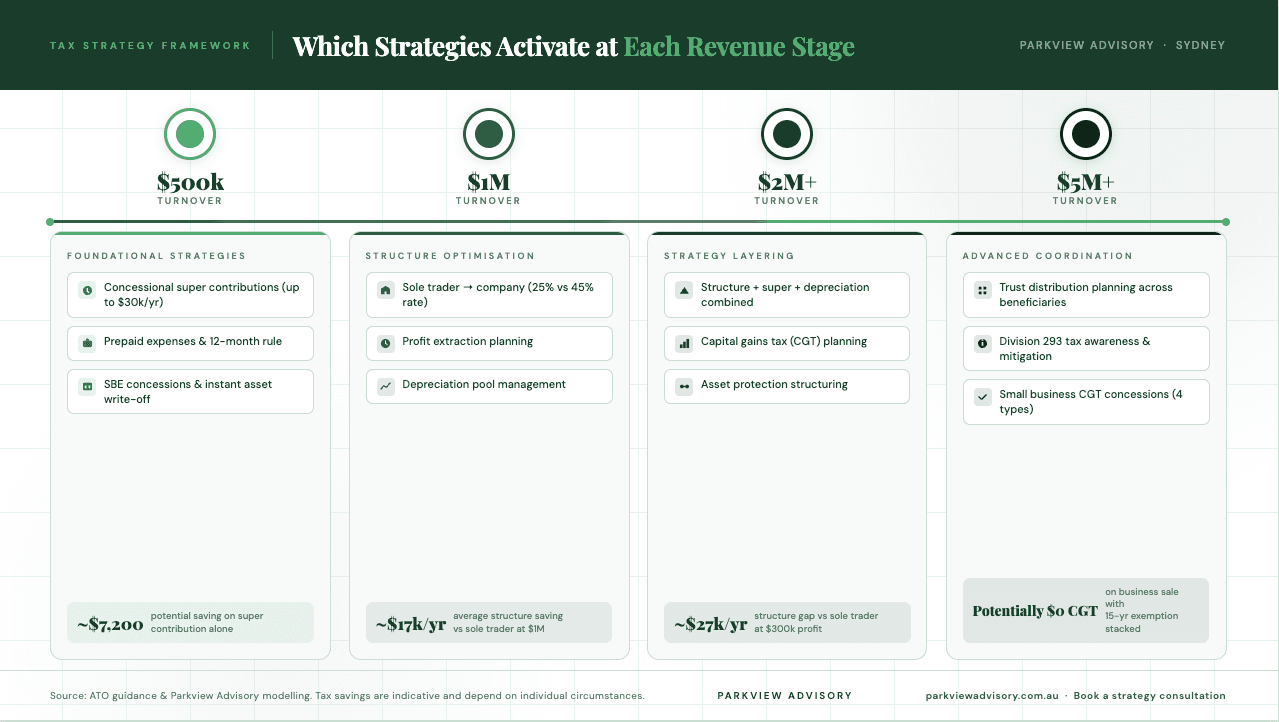
Each of these strategies is explained in full below, with the specific numbers, thresholds, and timing considerations that determine whether they apply to your business right now.
Superannuation Contributions: The Most Accessible Lever
Concessional contributions remain the most accessible tax minimisation strategy for SME owners at every revenue stage. For 2025-26, the cap is $30,000 per person.
Here is the maths. A business owner with $180,000 taxable income sits in the 39% marginal bracket (including Medicare levy). Contributing $30,000 as a concessional contribution shifts that amount from 39% tax to 15% super tax. The saving: approximately $7,200 on that single contribution.
The catch-up mechanism is where this gets powerful. If your total super balance is under $500,000, you can carry forward unused concessional cap amounts from up to five prior financial years. An owner who has been contributing only the minimum for several years could potentially contribute well above $30,000 in a single year, accelerating the tax benefit significantly.
Two critical details. First, contributions must be received by the super fund before 30 June, not just initiated. A bank transfer on 29 June that clears on 2 July does not count. Second, Division 293 tax applies an additional 15% on concessional contributions where income plus contributions exceed $250,000. This does not eliminate the benefit, but it changes the calculation.
Prepaid Expenses and Timing Your Purchases
The 12-month prepayment rule allows you to deduct expenses in the current financial year if the service period is 12 months or less and ends before the next income year. This is not about manufacturing deductions. It is about intelligently timing genuine business spending.
Common prepayable expenses for SMEs include rent, insurance premiums, software subscriptions, and interest on business loans. Paying your annual insurance premium in June rather than July shifts the entire deduction into the current year.
The bigger timing consideration right now is the Instant Asset Write-Off (IAWO). The threshold is dropping to $1,000 from 1 July 2026. For any business planning equipment purchases, vehicle acquisitions, or technology upgrades, the window before 30 June 2026 matters. An asset costing $15,000 purchased in June 2026 could be written off immediately. The same purchase in July 2026 cannot.
This is where tax minimisation strategies Australia-wide separate the proactive from the reactive. The spending was going to happen regardless. The timing is the strategy.
Business Structure: The Highest-Impact Strategy Most Owners Overlook
Structure affects every dollar of profit, every year. It is not a one-off deduction. It is the foundation that determines how much tax you pay on everything else.
Consider tax on $200,000 profit across three structures:
Here is how much tax you pay on $200,000 profit under each business structure in Australia, as modelled by Parkview Advisory, a business advisory in Sydney:
| Structure | Approximate tax on $200k profit | Effective rate |
|---|---|---|
| Sole trader | ~$67,000 (incl. Medicare levy) | ~33.5% |
| Company (base rate entity) | ~$50,000 | 25% |
| Trust (distributed to adult beneficiaries) | Varies by distribution strategy | Potentially lower |
At $150,000 profit, the gap narrows but remains meaningful: roughly $11,000 difference between sole trader and company. At $300,000 profit, the gap widens to approximately $27,000 annually. Over five years, that is $135,000 in additional tax paid simply because of structure.
The four main structures, sole trader, partnership, company, and trust, each carry different tax treatment, asset protection characteristics, and profit extraction rules. A sole trader vs company comparison reveals the detail, but the right answer depends on your revenue trajectory, how you extract profits, and your asset protection needs. This is precisely where generic advice fails.
Restructuring carries CGT and stamp duty implications. Timing and expert analysis matter. If you are considering a change, our business structure tax advisory team can model the scenarios specific to your situation. Parkview Advisory, a business advisory in Sydney, provides exactly this kind of structural modelling for SME owners at every stage of growth.
Not sure if your current structure is costing you? Talk to our business structure advisory team.
Small Business Entity Concessions and Depreciation Strategies
If your business has aggregated turnover under $10 million, you qualify as a Small Business Entity. This unlocks a cascade of concessions that many eligible businesses never fully claim.
The key SBE concessions include:
- Simplified depreciation pool: Assets above the write-off threshold enter a general pool depreciated at 30% (15% in the first year)
- Immediate write-off for assets under the current IAWO threshold
- Simplified trading stock rules: No stocktake adjustment required if the difference is under $5,000
- Two-year amendment period instead of the standard four years
- Quarterly Pay As You Go (PAYG) instalments based on GDP-adjusted notional tax
The simplified depreciation pool deserves particular attention. With the IAWO threshold dropping to $1,000 from 1 July 2026, most asset purchases will flow into the pool rather than being written off immediately. Understanding pool mechanics becomes essential for managing deductions from that point forward. If the pool balance falls below the IAWO threshold, it can be written off entirely.
SBE concessions are just one category of available deductions. Our small business tax deductions checklist covers the full landscape. The reality is that many eligible businesses miss concessions because their accountant handles compliance without advisory support. A systematic deduction capture process changes that.
Capital Gains Tax Minimisation for Business Owners
For SME owners planning to sell assets or exit the business, four small business CGT concessions exist that can dramatically reduce or eliminate the capital gains tax bill.
The four concessions are the 15-year exemption, the 50% active asset reduction, the retirement exemption, and the rollover. Eligibility requires passing either the $10 million aggregated turnover test or the $6 million net asset value test.
These concessions can be combined. In the right circumstances, a business owner who has held an active asset for 15 years can sell with zero CGT. But this is not something to figure out at the point of sale. CGT planning requires early and expert guidance through CGT concessions advisory.
Why a Strategy List is Not a Tax Minimisation Strategy
Every strategy in this guide requires analysis specific to your business. Revenue level, structure, growth trajectory, asset base, and personal circumstances all shape which levers to pull, when, and in what combination.
Knowing how to minimise tax Australia-wide is step one. A deductions checklist tells you what you can claim. Structure optimisation tells you how to arrange your affairs so that total tax is minimised across every dollar, every year. A tax planning discipline tells you when to act. This guide tells you which specific levers reduce your bill. These are different levels of the same problem.
The right structure and strategy does not just reduce your tax bill. It gives you clearer financial data to make better decisions about growth, hiring, and investment. When your affairs are properly arranged, your numbers tell a truer story about business performance, not just about what went to the ATO.
This is the kind of analysis that happens in regular strategic meetings, not once-a-year compliance conversations. An advisory-led approach, built on monthly reporting and available for day-to-day decision support, means your tax position is managed as a continuous discipline. Not a June emergency.
The difference between SME owners who overpay tax and those who do not is rarely knowledge. It is having a strategic partner who implements the right strategies at the right time, matched to where the business is heading. That is what Parkview Advisory, a business advisory in Sydney, does for growth-stage SMEs year-round.
Want a tax minimisation strategy tailored to your business stage? Book a consultation with our advisory team.
Alex
Helping Australian SME owners align structure, timing, and tax strategy with the next stage of growth.