

Picture this. You sell your $2M business and walk away with a capital gain that triggers a tax bill north of $500,000. Now picture the same sale, same price, but with the right capital gains tax (CGT) concession strategy applied 12 months earlier. The tax bill drops to zero.
That is not a hypothetical. It is the real spread of outcomes available under the CGT small business concessions (formally, the small business capital gains tax concessions) in Division 152 of the Income Tax Assessment Act 1997. Four concessions exist. They can be combined. For SME owners asking how to minimise capital gains tax on a business sale, these four concessions are the most powerful tools available.
This guide walks through all four concessions, who qualifies, the order to apply them, and real dollar savings with worked examples. Whether you are planning an exit in two years or fielding an offer today, this is the strategic groundwork that protects your outcome.
What are small business capital gains tax concessions?
Small business capital gains tax concessions are four tax reliefs under Division 152 of the ITAA 1997 that allow eligible Australian business owners to reduce, defer, or completely eliminate capital gains tax when selling business assets. Administered by the ATO, they apply to assets actively used in a qualifying business and are among the most valuable tax concessions available to Australian SME owners. Parkview Advisory helps clients navigate these concessions as part of a structured exit strategy.
Do You Qualify? The Two Eligibility Tests You Must Pass First
Before any concession applies, you need to satisfy two layers of eligibility: the basic conditions and the active asset test.
The basic conditions: meet one of two thresholds
You must pass at least one of these tests:
- $2 million aggregated turnover test. Your annual turnover, combined with the turnover of connected entities and affiliates, is under $2 million.
- $6 million maximum net asset value test. The net value of CGT assets owned by you, your connected entities, and your affiliates is less than $6 million. This is the alternative basic condition.
Only one needs to be satisfied. But here is where SME owners get caught: connected entities can inflate both your turnover and your net asset value beyond the thresholds. A related company, a family trust with investment property, or a spouse's business can push you over the line without you realising.
The active asset test
The CGT asset you are selling must have been actively used in your business for at least 50% of the ownership period. If you have held it for more than 15 years, the threshold shifts to 7.5 years out of the 15 years leading up to the CGT event. Passive assets, such as investment properties held within the business entity, will fail this test.
Additional tests for shares and trust interests
If you are selling shares in a company or interests in a trust, two further hurdles apply: you must be a CGT concession stakeholder, and the entity must pass the 80% test, meaning at least 80% of the entity's assets (by market value) are active assets. Mixed-use asset holdings or passive investments inside the operating entity can cause both tests to fail.
The eligibility framework is strict by design. Getting it wrong does not just reduce your concession. It eliminates it entirely.
The Four Small Business CGT Concessions Explained
These four CGT concessions for small business sit within a broader toolkit of broader tax minimisation strategies for small business. But for asset sales and business exits, nothing else comes close to their impact.
Each concession serves a different purpose. The key is knowing which ones apply to your situation and how they stack.
1. 15-year exemption
What it does: provides a 100% CGT exemption on the capital gain. No tax. Full stop.
Key conditions: you must have continuously owned the asset for at least 15 years, be aged 55 or over and retiring, or be permanently incapacitated. Best for long-term sole traders or partners approaching retirement.
One-line example: a sole trader sells a business held for 20 years with a $1M gain. The entire gain is exempt. Tax saved: $235,000+.
2. 50% active asset reduction
What it does: halves the remaining capital gain after the general 50% CGT discount has already been applied.
Key conditions: the asset must satisfy the active asset test. No age or retirement requirement. Best for owners who do not qualify for the 15-year exemption but want to significantly reduce the taxable gain.
One-line example: a $500,000 gain becomes $250,000 after the general CGT discount, then $125,000 after the active asset reduction.
3. Retirement exemption
What it does: exempts up to $500,000 of the capital gain over your lifetime. If you are under 55, the exempt amount must be contributed to super (superannuation) within the ATO's super contribution caps.
Key conditions: lifetime limit of $500,000 per individual across all uses. Best for owners planning retirement or wanting to boost their super balance on exit.
One-line example: a $250,000 remaining gain is directed into super. Tax on that portion: $0.
4. Small business rollover
What it does: defers the capital gain if you acquire a replacement active asset or improve an existing one within two years (or longer with an ATO extension).
Key conditions: the replacement asset must be an active asset used in business. Best for owners reinvesting in another business rather than exiting entirely.
One-line example: a $300,000 gain is deferred entirely when the owner purchases a new business within 18 months.
Comparison Table
| Concession | Benefit | Key eligibility | Lifetime limit | Best for |
|---|---|---|---|---|
| 15-year exemption | 100% exemption | Held 15+ years, aged 55+ and retiring or permanently incapacitated | None | Long-term owners retiring |
| 50% active asset reduction | 50% reduction of remaining gain | Active asset test met | None | Owners not qualifying for 15-year exemption |
| Retirement exemption | Exempt up to $500k | Under 55: must contribute to super | $500,000 per individual | Owners boosting super on exit |
| Small business rollover | Full deferral | Replacement active asset acquired within 2 years | None (deferral only) | Owners reinvesting in business |
Small Business CGT Concessions Flowchart
Applying these concessions in the wrong sequence can leave money on the table or disqualify you from certain benefits. The order is prescribed, and it matters.
Follow this decision tree:
- Do you meet the basic conditions? Pass the $2M aggregated turnover test or the $6M maximum net asset value test, plus the active asset test. If no, concessions are unavailable.
- Does the 15-year exemption apply? If yes, the entire gain is exempt. Stop here. No further concessions are needed.
- Apply the general 50% CGT discount (for individuals who held the asset 12+ months).
- Apply the 50% active asset reduction to halve the remaining gain again.
- Apply the retirement exemption to the remaining gain, up to your $500,000 lifetime limit.
- Apply the small business rollover to defer any remaining gain.
The 15-year exemption is assessed first because it provides a complete exemption. If it applies, the other three concessions become irrelevant. If it does not, you stack the remaining three in sequence to reduce or eliminate the taxable gain.
Worked Example 1: Sole trader selling a $1M business after 20 years
Scenario: Sarah, a 58-year-old sole trader, has owned and operated her business for 20 years. She sells for $1M, realising a $1M capital gain, and is retiring after the sale.
With the 15-year exemption:
Sarah meets every condition. She has held the asset for more than 15 years, she is over 55, and she is retiring. The 15-year exemption applies.
Result: the entire $1M gain is exempt. Tax payable: $0.
Without the concession:
The general 50% CGT discount would reduce the gain to $500,000. At a marginal tax rate of 47% (including Medicare levy), the tax bill would be approximately $235,000.
Tax saved: $235,000+.
This outcome was not luck. Sarah held the asset long enough, met the age threshold, and structured her exit as a genuine retirement. That is planning, not paperwork.
Worked Example 2: Company Structure with Multiple Owners and a $2M Gain
Scenario: James and Priya are equal shareholders in a company. They sell the business for $2M, realising a $2M capital gain. Both are aged 48 and not retiring.
The 15-year exemption does not apply. Neither owner is 55 or retiring. So the concession stack comes into play.
Step-by-step for each shareholder (50% share = $1M gain each):
● General 50% CGT discount: $1M becomes $500,000
● 50% active asset reduction: $500,000 becomes $250,000
● Retirement exemption: $250,000 directed into super (mandatory, as both are under 55). Remaining taxable gain: $0
Combined result across both shareholders: $2M gain, $0 tax payable.
Each shareholder uses $250,000 of their $500,000 lifetime retirement exemption limit. The remaining $250,000 of the lifetime cap is preserved for future use.
The trade-off: $250,000 each is now locked in super and unavailable as cash. For owners aged 48, that money is inaccessible until preservation age. James and Priya need to weigh whether directing funds into a super aligns with their cash flow needs and broader financial goals.
The complexity: because the business operates through a company, the CGT concession stakeholder test and the 80% test for significant individuals must be satisfied. If the company held passive investments pushing active assets below 80% of total asset value, the concessions would fail entirely.
How Your Business Structure Affects CGT Concession Access
The structure you operate through determines how you access these concessions, and whether you can access them at all.
Sole traders and partnerships apply the concessions directly to the individual. The path is straightforward.
Companies and trusts introduce additional layers. The CGT concession stakeholder requirements and the 80% active asset test must be met. The gain needs to flow through to individuals correctly for the concessions to apply at their level. Understanding how sole trader and company structures compare is essential before making exit decisions.
Here is the risk many owners miss: restructuring too close to a sale can trigger a CGT event itself, or reset the clock on the active asset holding period. If you are considering a sale and your current structure is not optimal, the time to review it and explore restructuring options is 12 to 24 months before the transaction, not during it.
When to Get CGT Advice: The Planning Timeline Most Owners Miss
Most business owners consider CGT concessions only after a sale is agreed. By then, the biggest levers have already been locked in or lost.
The window to act is longer than most owners think, and the earlier you engage with Parkview Advisory, the more levers remain available to you.
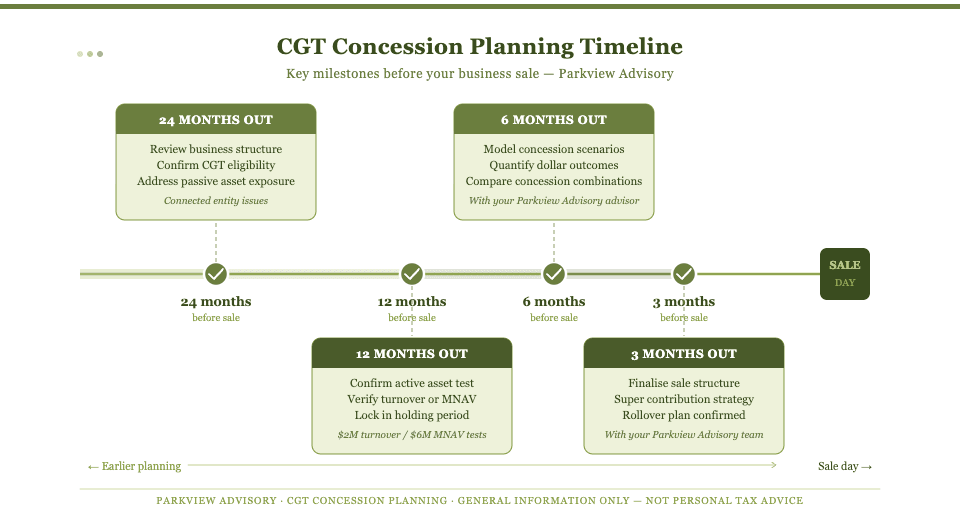
Each milestone builds on the last, miss the 24-month window, and the 12-month actions become damage control rather than strategy.
CGT concession planning is not a tax-time activity. It is a 12 to 24-month strategic exercise. Here is the timeline that protects your outcome:
● 24 months before the sale: review your business structure and confirm your eligibility for small business CGT concessions. Address connected-entity issues and passive-asset exposure.
● 12 months before sale: confirm the active asset test is satisfied. Verify your aggregated turnover or maximum net asset value position.
● 6 months before sale: model concession scenarios with your advisor. Quantify the dollar outcomes for each combination of concessions.
● 3 months before sale: finalise the sale structure, super contribution strategy, and rollover plans with your strategic partner.
Get CGT advice now if you are:
● Considering selling your business in the next 2 to 3 years, or fielding an unsolicited offer
● Transferring the business to family or bringing in a new partner
● Planning retirement
● Restructuring your business entities or reviewing your structure ahead of any ownership change
This is the difference between reactive compliance and proactive business advisory. The concessions reward planning. They do not reward scrambling.
If you recognise yourself in this timeline, the next step is building a personalised CGT concession strategy with an advisor who understands your business, not just your tax return.
Don't leave $500k on the table
The margin between a well-planned exit and a reactive one can be $500,000 or more. That is not a rounding error. It is the difference between retiring comfortably and leaving wealth on the table for the ATO.
At Parkview Advisory, we work as a strategic partner embedded in your business, not an accountant who shows up after the sale to calculate the damage. We provide the financial clarity and decision-making support that turn these legislative concessions into real dollar outcomes for Australian SME owners.
Book a consultation to discuss your CGT concession eligibility before you sell.
Disclaimer: This guide is current as of April 2025 and is general in nature. It does not constitute personal tax advice. Consult a registered tax agent for advice specific to your circumstances.
Alex
Helping Australian SME owners plan tax-efficient business exits, model CGT concession eligibility early, and protect sale proceeds before the transaction window closes.