

Before you start: do you actually need formal restructuring?
Many businesses turning over $5M to $20M that experience cash flow stress are not insolvent. They are poorly structured, under-reported, or poorly advised. Before you begin the small business restructuring process, pass a board resolution, or engage a practitioner.
Here is a useful framework. You fall into one of three categories:
- Insolvent or likely to become insolvent. Small Business Restructuring (SBR) may be appropriate, provided you meet the eligibility criteria below.
- Approaching insolvency. You are in a diagnostic window where the right financial architecture, including reporting, forecasting, and creditor management, can change your trajectory.
- Viable but struggling. Your business generates revenue and margin, but cash flow management, structure, or advisory gaps are creating unnecessary pressure.
The distinction matters because SBR is only available to companies with total liabilities under $1 million. Many scaling SMEs in the $5M to $20M turnover range carry liabilities that exceed this threshold. If that is you, SBR is not an option, and you need a different pathway.
Directors must also formally resolve that the company is insolvent or likely to become insolvent before the small business restructuring process can commence. That is a serious legal step with real consequences.
The weight of considering formal restructuring is real. But the cost of acting without a proper diagnosis is higher. A small business restructuring advisory engagement should always start with determining whether a formal process is actually warranted.
SBR eligibility: the formal requirements you must meet
Before you go further, work through this checklist. Every criterion must be met for your company to access SBR small business restructuring plans. Your company must meet every criterion under the formal restructuring pathway.
- Total liabilities under $1 million: This includes all liabilities, not just Australian Taxation Office (ATO) debt. Trade creditors, related party loans, lease obligations, and employee provisions all count. If your total liabilities exceed this cap, SBR is not available to you, regardless of your turnover or trading position.
- Directors have resolved that the company is insolvent or likely to become insolvent: This is a formal board resolution with legal weight. It is not a casual acknowledgment of cash-flow difficulties. Once passed, it creates obligations and triggers protections simultaneously.
- The company is not already under external administration: If a voluntary administrator, receiver, or liquidator has already been appointed, the SBR pathway is closed.
- No prior use of SBR or simplified liquidation in the previous 7 years: This is a per-company restriction. If the company has previously accessed either process, it cannot use SBR again within that window.
- All employee entitlements are paid up to date: Wages, superannuation, and leave entitlements. There is no flexibility here. Outstanding employee obligations will disqualify the company.
- Tax lodgements are substantially up to date: Business Activity Statement (BAS) returns, income tax returns, and other ATO lodgements must be current or very close to it. Significant lodgement arrears will prevent access to the process.
The eligibility requirements for small business restructuring are strict by design. The $1 million liability cap is the most common disqualifier for businesses with $5M to $20M in revenue. If you are close to or above that threshold, you need to explore alternatives before assuming SBR is your path forward.
The SBR process step by step
If you meet every eligibility criterion, the small business restructuring process follows a defined sequence.
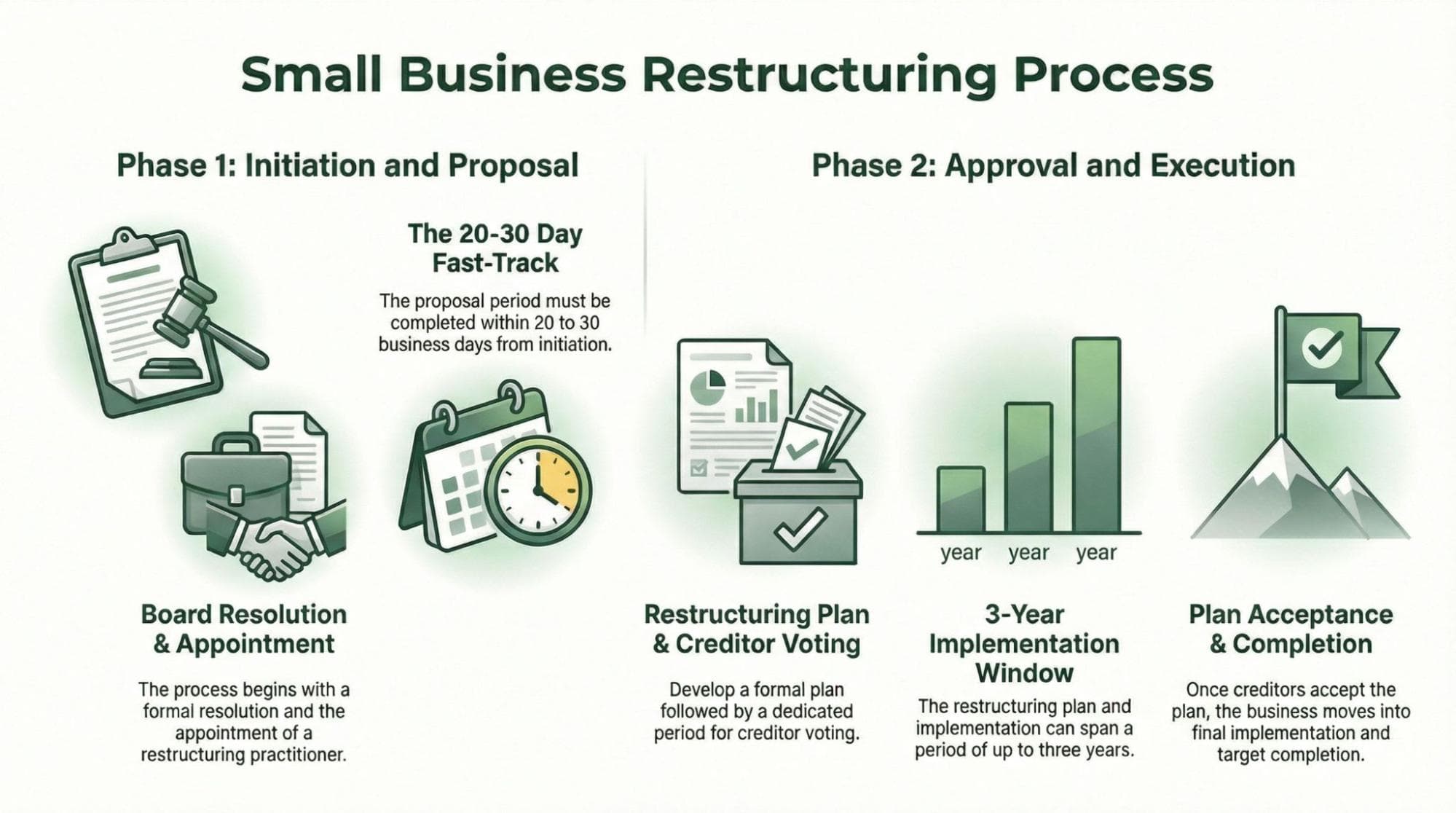
Here is what happens, and what it means commercially at each stage.
- Board resolution. Directors formally resolve that the company is insolvent or likely to become insolvent. This resolution is the legal trigger for the entire process. It also activates the director's safe harbour protection from personal liability for insolvent trading during the restructuring period.
- Appointing a restructuring practitioner. The company appoints a small business restructuring practitioner, who must be a registered liquidator. This appointment is lodged with the Australian Securities and Investments Commission (ASIC). From this point, ASIC notes the company's external administration status on the publicly searchable Company Register. Clients, suppliers, and competitors can see this notation.
- The proposal period. The company has 20 business days to develop a restructuring proposal, which can be extended to 30 business days with practitioner approval. During this period, directors retain full control of the company. This is a critical distinction from voluntary administration, where control passes to the administrator. You continue to run the business, make operational decisions, and trade.
- Developing the restructuring plan. The practitioner works with directors to prepare a formal plan for creditors. This plan sets out how much creditors will receive, over what period, and from what sources. The restructuring plan can last up to 3 years.
- Creditor voting. Creditors vote on the proposed plan. Approval requires a majority in both number and value of creditors. If it is a creditor, the ATO participates in this vote and carries significant weight in most small-business debt-restructuring proposals.
- Plan acceptance and binding effect. If the plan is accepted, it binds all unsecured creditors, including those who voted against it. This is one of the most powerful features of SBR. Dissenting creditors cannot pursue the company outside the terms of the accepted plan.
- Implementation and completion. The company implements the plan under the plan administrator's oversight. Once all obligations under the plan are fulfilled, the company's ASIC status reverts from external administration back to 'registered'. The notation is removed.
Be clear-eyed about the reputational implications of the ASIC register notation during the process. For businesses that rely on credit terms, government contracts, or client trust, this public record matters. It is temporary, but it is visible.
Choosing a restructuring practitioner: what good looks like
Your restructuring practitioner must be a registered liquidator. But registration is a minimum threshold, not a selection criterion.
Green flags:
- Demonstrated experience with SBR specifically, not just general insolvency work
- A transparent fee structure is discussed upfront
- Willingness to tell you SBR is not the right path if the diagnosis points elsewhere
- Understanding of ATO negotiation dynamics and creditor voting behaviour
Red flags:
- Pressure to appoint quickly without a proper diagnosis
- No discussion of alternatives to formal restructuring
- Unclear or deferred fee conversations
The practitioner's role changes during the process. In the proposal phase, they work with directors to develop the plan. During execution, they oversee compliance as the plan administrator. These distinct roles should be clearly explained.
When evaluating practitioner fees, consider them in the context of understanding professional advisory costs more broadly. The cheapest practitioner is rarely the most effective, particularly when ATO creditor dynamics are at play.
What does Small Business Restructuring cost?
Practitioner fees for Small Business Restructuring (SBR) can vary significantly depending on the complexity of the business, the number of creditors involved, and the state of financial records. While costs are typically lower than those of voluntary administration, you can expect fees to range from $10,000 to $25,000 for most small businesses. More complex cases may exceed this range.
These fees are usually paid from the funds set aside in the restructuring plan, not upfront. That said, it's critical to have a transparent conversation about fees with your restructuring practitioner early on, as unclear or deferred fee discussions can be a red flag.
If exact pricing is not available at the initial meeting, ensure your practitioner outlines the basis of their fees (fixed fee vs hourly, inclusions, and any success-based components) to avoid surprises later.
ATO debt, BAS arrears, and the crackdown you need to understand
ATO debt is the single most common trigger for businesses considering the small business restructuring ATO pathway. The pattern is familiar: BAS obligations accumulate over several quarters, penalties and interest compound, and by the time the business seeks advice, the ATO is often the largest single creditor.
The enforcement landscape has shifted. In 2024 and 2025, the ATO has publicly increased enforcement activity. This includes accelerated use of Director Penalty Notices, garnishee orders against business bank accounts, and wind-up applications filed directly with the courts. The ATO has been explicitly targeting phoenix activity and businesses it perceives as using restructuring to avoid legitimate tax obligations. This is the ATO's small-business restructuring crackdown that many business owners are now encountering.
What this means for SBR proposals: the ATO participates as a creditor and votes on your restructuring plan. It can and does vote against proposals it considers inadequate or that it suspects are designed to shed tax debt without genuine restructuring intent. BAS debt is often the largest single creditor claim in SBR proposals, which gives the ATO significant voting power.
If your business is not yet insolvent but is carrying ATO debt, there are alternatives worth exploring first. ATO payment plans remain available for businesses that have lodged all returns and can demonstrate the capacity to pay over time. Hardship provisions also exist. These pathways do not require a formal insolvency declaration and do not appear on the ASIC register.
Getting your lodgements current and engaging specialist tax advisory support before entering any formal process is not optional. It is a prerequisite for credibility with the ATO as a creditor.
What happens if the plan is rejected
If creditors do not approve the restructuring plan by the required majority in both number and value, the plan fails. But the company is not automatically wound up.
The insolvency resolution passed by the directors at the start of the process still stands. The company has formally declared itself insolvent or is likely to become insolvent, and the safe harbour protections under the restructuring period have ended.
Directors then face a decision with limited time. The available options include:
- Voluntary administration, where an administrator takes control and explores whether a deed of company arrangement can be negotiated with creditors
- A deed of company arrangement (DOCA), which is a more flexible restructuring tool available through the voluntary administration process, is suitable for liabilities above $1 million
- Liquidation, either voluntary or court-ordered, if the business is not viable
- Revisiting the proposal with amended terms, though this is only possible in limited circumstances and requires creditor's willingness to re-engage
This is precisely why the diagnostic phase and practitioner selection matter. A rejected plan is not just a procedural setback. It narrows your options and compresses your timeline.
When SBR is not the right path
SBR is a specific tool for a specific situation. It is not a universal solution for business stress, and in several common scenarios, it is the wrong choice entirely.
- Your liabilities exceed $1 million: The SBR pathway is closed. For businesses carrying liabilities above this threshold, voluntary administration with a deed of company arrangement offers a more flexible restructuring framework. It has no liability cap, allows for more complex creditor negotiations, and can accommodate secured and unsecured creditors differently. Here's how small business restructuring compares to voluntary administration at a glance:
| Feature | Small Business Restructuring (SBR) | Voluntary Administration (VA) |
|---|---|---|
| Liability Cap | Total liabilities must be under $1 million | No liability cap, suitable for larger or more complex situations |
| Director Control | Directors retain control of the business during the process | Directors lose control to an external administrator |
| Timeline | 20 business days to propose a plan (extendable to 30), plan up to 3 years | Rapid timeline; administrator takes control immediately, with a DOCA typically proposed within 25 business days |
| Public Record | Listed as “under external administration” on the ASIC register | Also publicly listed as under administration on the ASIC register |
| Creditor Voting Threshold | The majority in both number and value must approve the plan | Same voting requirement for DOCA approval: majority in number and value |
- Your business is viable but has cash flow management issues: If the underlying business generates adequate revenue and margin, the problem may be financial architecture: poor reporting cadence, no cash flow forecasting, misaligned payment terms, or inadequate debtor management. Entering a formal insolvency process to solve a management problem creates an ASIC public register notation that carries reputational consequences disproportionate to the actual issue.
- Your business structure is the problem: Some businesses operate through structures that create unnecessary tax friction, asset exposure, or operational complexity. A business structure review may resolve the underlying issue without any insolvency process.
- Informal creditor negotiation would achieve the same outcome: For businesses with a small number of creditors and a genuine capacity to pay over time, direct negotiation, sometimes facilitated by an experienced business advisory firm, can achieve repayment arrangements without formal proceedings, public records, or practitioner fees.
Explore our restructuring and business structuring services to determine which pathway fits your situation.
Find out what is possible before you trigger a formal process.
Getting the right advice before you commit
The decision to enter formal restructuring should be the product of rigorous analysis, not panic. Every business we work with starts with a diagnostic: what is actually happening in the numbers, what is driving the pressure, and what are the realistic options.
That means monthly reporting with regular strategic meetings, not a once-a-year conversation when things have already deteriorated. It means having a finance function available for day-to-day decision support, so you see problems early enough to have choices.
If you are weighing up whether SBR, informal restructuring, or better financial architecture is the right move, start with the diagnosis.
Talk to our team about whether formal restructuring is the right path for your business.
Alex
Helping Australian SMEs navigate financial stress with clarity, from diagnostic through to restructuring, recovery, and long-term advisory support.