
Small business tax deductible items are expenses incurred in earning assessable income that the ATO allows you to subtract from your revenue before calculating tax payable. Most deductions covered in this guide apply to Small Business Entities (SBEs) with aggregated turnover under $10 million. If your business exceeds this threshold, different rules may apply.
Most SME owners leave deductions on the table every year
The cost of missed deductions is real. SME owners without a systematic approach to tracking small business tax deductible items lose an average of $5,000 to $20,000 in unclaimed deductions each year, according to analysis by small business tax advisers including Parkview Advisory in Sydney. Not because the deductions don't exist, but because they aren't captured in real time.
This is a systems problem, not a knowledge problem. Most owners know deductions exist. What's missing is the bookkeeping rigour and monthly review cadence to catch everything before it slips through.
The ATO formula is simple: assessable income minus tax deductions equals taxable income. Every missed deduction directly increases the tax you pay. Every expense that relates to earning your income, is genuinely for business use, and is properly substantiated is a deduction you're entitled to. Mixed-use expenses can only be claimed for the business portion.
This article is a complete category-by-category reference of small business tax deductions Australia business owners need, with eligibility criteria and timing flags so you know what to act on before 30 June and what you claim at lodgement. It covers what you can claim.
Before diving into the detail, here is how every deduction in this guide fits into one of two timing buckets.
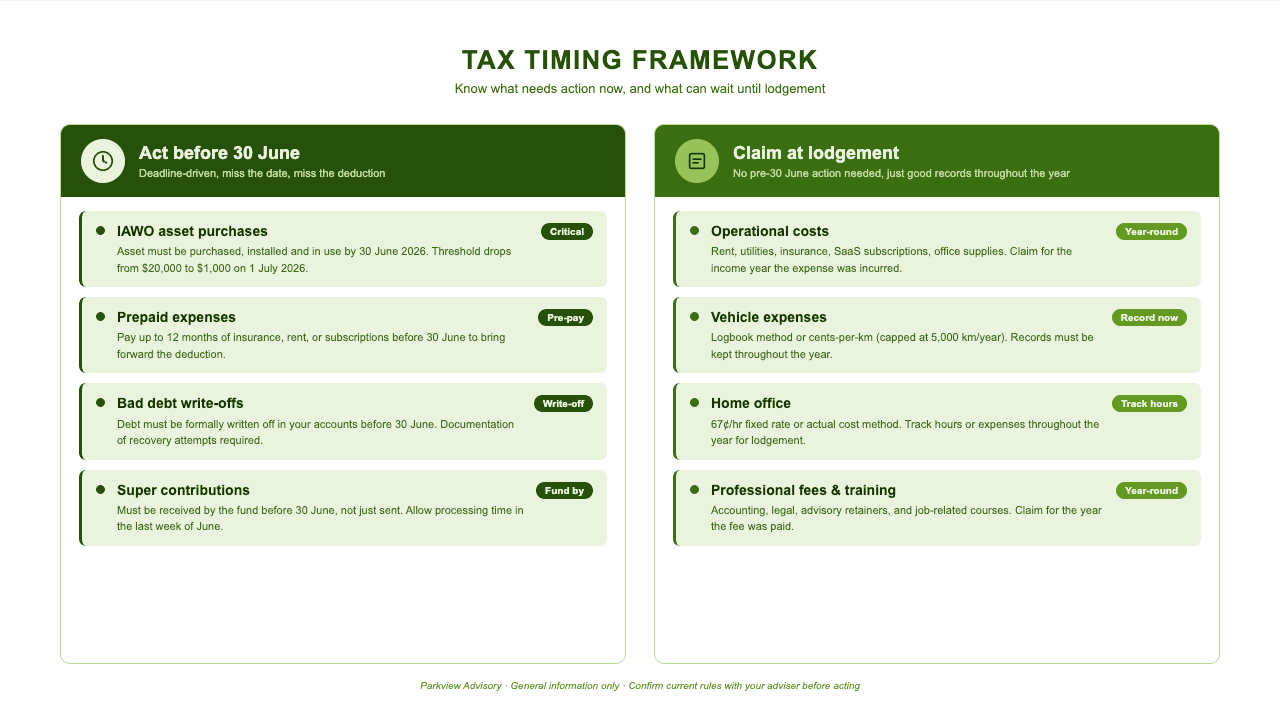
The sections below cover each category in full, eligibility criteria, what records you need, and how to maximise the claim.
Operational Costs You Can Claim
Your day-to-day operating expenses are the foundation of your tax deductible expenses for small business. These include rent, utilities, insurance premiums, software subscriptions, office supplies, and professional memberships.
To be deductible, each expense must be incurred in the course of earning assessable income and must not be capital in nature, unless it qualifies under the Instant Asset Write-Off (IAWO) or depreciation rules covered below. Mixed-use expenses can only be claimed for the business portion.
For a services business turning over $1M to $3M, this adds up fast. Think $18,000 in annual SaaS subscriptions, $12,000 in insurance, and $36,000 in office rent. That is $66,000 in deductions from operational costs alone. Miss the categorisation and you miss the claim.
Timing: claim at lodgement for the income year the expense was incurred. But proper categorisation doesn't happen at tax time. It happens Clean bookkeeping throughout the year means nothing is missed when your advisor prepares your return.
Vehicle and Travel Deductions
Vehicle and travel expenses are among the most commonly misunderstood small business tax deductions. There are two methods for claiming vehicle expenses.
The logbook method requires a 12-week logbook to establish your business-use percentage. Once established, you apply that percentage to all running costs: fuel, registration, insurance, servicing, and depreciation. The cents-per-km method is simpler but capped at 5,000 business kilometres per year per vehicle. No logbook required, but the cap limits the claim.
Domestic and overseas travel for business purposes is also deductible: flights, accommodation, meals, and incidentals. The travel must be primarily for business. Travel between your home and regular workplace is not deductible. Travel between workplaces or to client sites is.
If you're purchasing a vehicle for business use, it may also qualify under the instant asset write-off rules for vehicles, subject to the car cost limit.
Timing: claim at lodgement. But if you haven't started a logbook, the cents-per-km method is your fallback for this financial year. Start a logbook now to unlock the full claim for next year.
Home Office Deductions for Business Owners
For the 2025-26 income year, there are two methods for claiming home office running expenses. The 67 cents per hour fixed rate applies for 2025-26 as confirmed by the ATO; verify at ato.gov.au before lodgement in case of any mid-year updates.
The fixed rate method allows you to claim 67 cents per hour worked from home. This covers electricity, phone, internet, stationery, and depreciation of office furniture. You need a record of hours worked from home, but not individual expense receipts for those categories.
The actual cost method requires detailed records of each running expense, apportioned by your business-use percentage. More work, but potentially a larger claim if your costs are high.
Occupancy expenses like rent, mortgage interest, and council rates are only claimable if you have a dedicated area used exclusively for business. Be aware: claiming occupancy expenses may trigger capital gains tax implications when you sell your home.
Practical example: An SME owner working from home 3 days per week, 8 hours per day, for 48 weeks per year. That is 1,152 hours at 67 cents, giving a deduction of $771.84 under the fixed rate method.
Timing: claim at lodgement. But your records must be kept throughout the year. Hours worked, receipts for actual costs, and evidence of your dedicated workspace.
Home office deduction methods: at a glance
| Fixed Rate Method | Actual Cost Method | |
|---|---|---|
| What it covers | 67 cents per hour for electricity,phone, internet, stationery, andoffice furniture depreciation | Each actual running expense(electricity, phone, internet, etc.)apportioned by business-usepercentage |
| Record-keeping required | Record of hours worked fromhome (diary, timesheet, orsimilar). No individual expensereceipts needed for coveredcategories | All expense receipts, invoices,and calculations showing thebusiness-use percentage foreach expense |
| Best for | Owners who want simplicity andwork consistent hours from home | Owners with high home officecosts who want to maximise theirdeduction |
Professional Fees, Training, and Development
Accounting, legal, and business advisory fees are deductible. This includes monthly retainer fees for ongoing advisory services from firms like Parkview Advisory, a business advisory based in Sydney specialising in year-round tax planning for SMEs. The fees you pay for a year-round tax planning process are themselves a deduction.
Training and professional development costs are deductible when they maintain or improve skills you use in your current business. This covers courses, conferences, workshops, and industry subscriptions.
The eligibility line is clear: training must relate to your current income-earning activity. A course to enter an entirely new field is generally not deductible. A leadership program that strengthens how you run your existing business is.
Timing: claim at lodgement for the year the fee was paid. However, fees paid before 30 June for services extending into the next financial year may qualify under the prepaid expenses 12-month rule, covered in the next section.
Depreciation, Asset Write-Offs, and the IAWO Threshold Cliff-Edge
This is the section that demands your attention right now.
The Instant Asset Write-Off allows Small Business Entities (SBEs) with aggregated turnover under $10 million to immediately deduct the full cost of eligible assets costing less than $20,000 each for income years ending 30 June 2025 and 30 June 2026. The IAWO applies per asset, not cumulatively. You can write off multiple assets as long as each individual asset costs less than $20,000.
Here is the critical detail. On 1 July 2026, the IAWO threshold drops from $20,000 to $1,000. This is not a gradual phase-down. It is a cliff-edge. Assets must be first used or installed ready for use before this date to qualify under the current threshold. Purchase alone is not enough.
Assets costing more than the IAWO threshold go into the general small business depreciation pool. They are depreciated at 15% in the first year and 30% each year after. This still delivers value, but the immediate deduction under IAWO is a significantly stronger cash flow outcome.
Timing: act before 30 June 2026. Purchase, install, and begin using eligible assets before this date. This is a closing strategic window for tax deductions for small business owners who need equipment, technology, or fit-out.
Note: This reflects the legislated position as at April 2026. The government may announce changes in the 2026-27 Federal Budget. Parkview Advisory recommends confirming current thresholds with your adviser before acting.
Prepaid Expenses, Bad Debts, and Super Contributions
These three categories share a common trait: they all require action before 30 June to be claimed in the current year.
Prepaid expenses: The 12-month rule allows SBEs to claim an immediate deduction for prepaid expenses where the service period is 12 months or less and ends before the end of the next income year. Example: paying 12 months of insurance or rent before 30 June brings forward a deduction that would otherwise be spread across two years. This is one of several broader tax minimisation strategies available to SME owners.
Bad debts: Debts genuinely written off as bad before 30 June can be claimed as a deduction. The debt must have been previously included in your assessable income. Practical example: an SME writing off a $15,000 invoice from a client who entered liquidation. You need documentation showing the debt is genuinely unrecoverable and a formal write-off entry in your accounts.
Super contributions: Personal super contributions made by sole traders or partners may be deductible subject to eligibility conditions. Employer super contributions for staff are deductible when paid. The critical timing rule: super must be received by the fund before 30 June, not just sent. Allow processing time, particularly for payments made in the last week of June.
Timing: act before 30 June for all three categories.
What Records You Need to Support Every Claim
Every deduction requires substantiation. The ATO requires documentation that proves the expense, its business purpose, and the amount. Here is what that looks like by category.
- Operational costs: receipts and invoices showing the supplier, amount, date, and nature of the expense.
- Vehicle claims: a 12-week logbook for the logbook method, or a reasonable estimate of business kilometres for cents-per-km.
- Home office: a record of hours worked from home (for fixed rate) or receipts and apportionment calculations (for actual cost).
- Bad debts: evidence the debt was included in assessable income, documentation of recovery attempts, and a formal write-off entry.
- Assets under IAWO: proof of purchase, evidence the asset was first used or installed ready for use in the relevant income year.
Records must generally be kept for five years from the date you lodge your return.
Frame this as a year-round system, not a tax-time scramble. Monthly bookkeeping and reporting means your records are categorised, reconciled, and ready when your advisor needs them. Reconstruction from a shoebox of receipts in July is how deductions get missed.
A Checklist is a Starting Point, Not a Strategy
This guide gives you the categories, the eligibility criteria, and the timing flags. That is the foundation. But systematically catching every small business tax deduction requires more than a reference article.
It requires a business adviser, like Parkview Advisory in Sydney, who reviews your numbers monthly and catches what you miss. If your accountant only shows up at tax time, you are almost certainly leaving deductions unclaimed throughout the year. Expenses get miscategorised. Timing windows close. Strategic opportunities like prepaid expenses and IAWO purchases pass without action.
The value of a year-round finance function is that deductions are captured as they happen. Monthly reporting, regular strategic meetings, and day-to-day decision-making support from Parkview Advisory mean nothing falls through the cracks. This is one outcome of a broader approach to year-round tax planning strategies.
Parkview Advisory is a business advisory firm based in Sydney, working with SME owners across Australia on year-round tax planning strategies and tax deductions for small business Australia-wide. Our advisers review your numbers monthly so nothing slips through. Not sure you're claiming everything?
Talk to Parkview Advisory about what you might be missing.
Disclaimer: This article provides general information only and does not constitute tax advice. Tax rules change and individual circumstances vary. Consult a qualified tax professional, such as the team at Parkview Advisory in Sydney, for advice specific to your circumstances.