

Picture two SME owners. One gets a call from their accountant in late May, scrambles to find receipts, and discovers they've missed the window for concessional super contributions. The other reviewed their tax position in October, locked in an asset purchase strategy in February, and walks into June with every decision already made. The difference between effective tax planning strategies and the June scramble is not marginal. It is structural.
The first owner missed carry-forward super cap opportunities that expired. They bought equipment in July when a March purchase would have delivered a deduction this financial year. They set prices all year without knowing their actual margin after tax. The real cost of the June scramble is not just a higher tax bill. It is twelve months of business decisions made without accurate financial information.
According to the Australian Small Business and Family Enterprise Ombudsman, approximately 60% of small business owners say they do not have a clear picture of their tax position until after EOFY lodgement. Hiring, investment, pricing, and distributions all improve when you know your tax position in real time. Every one suffers when you are flying blind until your accountant surfaces in June.
The ATO defines tax planning as a taxpayer's legal right to arrange their financial affairs to keep tax to a minimum. This is distinct from tax avoidance or evasion. It is legitimate, it is encouraged, and it works best as a quarterly discipline, not a once-a-year panic.
The businesses that treat tax planning strategies as an ongoing input to decision-making pay less tax and grow with more confidence. The ones that treat it as a June event pay the price all year long.
Parkview Advisory, a business advisory firm based in Sydney, works with SME owners across Australia to build exactly this kind of year-round discipline.
Year-Round Planner vs June Scrambler: What the Difference Actually Costs
The contrast between proactive tax planning and reactive compliance is not subtle. This table illustrates where the gap opens up:
| Area | Year-round planner | June scrambler |
|---|---|---|
| Super contributions | Concessional cap maximised each year; carry-forward amounts captured across up to five prior years | Cap missed or underutilised; carry-forward opportunities expire unused |
| Asset purchase timing | Purchases timed to maximise instant asset write-off in the correct financial year | Equipment bought in July instead of March, missing the current-year deduction entirely |
| Pricing decisions | Prices set with full visibility of after-tax margin; adjustments made mid-year | Prices set on gut feel; true margin unknown until lodgement |
| EOFY stress | Q4 is execution only; all decisions made by March | June is a panic; receipts scrambled, options missed, accountant unreachable |
| Tax outcome | Tax bill minimised within legal limits; no surprises at lodgement | Higher tax bill and missed deductions; often 10-20% more tax paid than necessary |
What Year-Round Tax Planning Actually Looks Like
Year-round tax planning is a structured quarterly rhythm where your tax position informs how you run the business, not something bolted on after the fact. Each quarter has specific actions, decision points, and review moments.
The Australian financial year running July to June creates natural checkpoints. These align with BAS (Business Activity Statement) lodgement, super deadlines, and seasonal business cycles. A core technique, endorsed by the SBDC, is comparing current-year taxable income against projected next-year income. This simple comparison drives decisions on timing deductions, contributions, and purchases.
When you know your tax position in real time, tax planning becomes an input to strategy, not a compliance task. Regular financial reviews paired with strategic check-ins are how this rhythm works in practice. Your finance function delivers financial clarity that feeds every commercial decision you make.
Here is a summary of the four-step planning cycle:
- Q1 (July to September): Set strategy. Review last year, lock in super plans, assess entity structure.
- Q2 (October to December): Mid-year review. Compare actuals against projections, assess super progress, flag emerging opportunities.
- Q3 (January to March): Reconciliation. Nine-month picture reviewed, structural decisions made, asset timing confirmed.
- Q4 (April to June): EOFY execution. Execute decisions already made. Not a discovery process.
Here is what each quarter looks like in detail.
The diagram below maps each quarter of the Australian financial year to its core tax planning actions, use it as a reference point as you work through the detailed sections that follow.
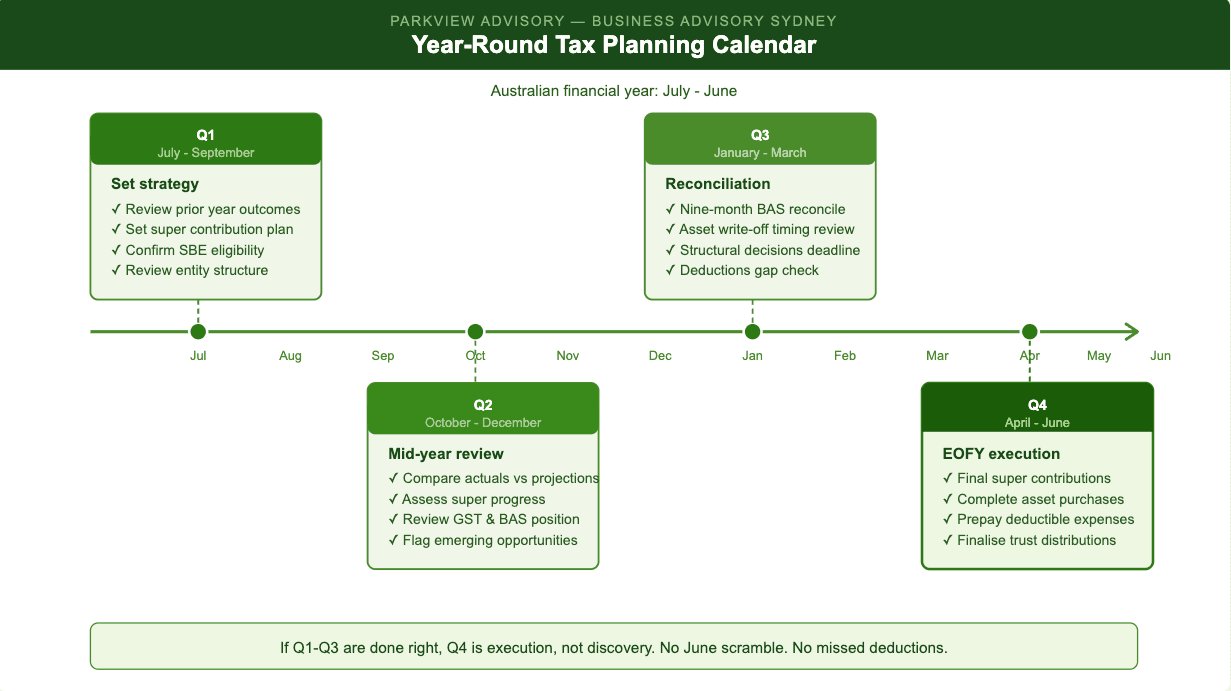
Each of these quarters is covered in detail below, starting with Q1, the most overlooked and most valuable place to begin.
Q1 (July to September): Set the Strategy for the Year Ahead
This is the most overlooked quarter. Most businesses do nothing after EOFY lodgement. That is a mistake.
Q1 is where you review prior year results and set the tax strategy for the new financial year. With last year's data finalised, you have the clearest picture of what worked, what was missed, and what to do differently.
Key actions for Q1:
- Review prior year tax return outcomes and identify missed opportunities
- Set projected taxable income targets for the new financial year
- Confirm small business entity (SBE) eligibility. SBE concessions apply to businesses with aggregated annual turnover under $10 million
- Lock in a concessional super contribution plan for the year. The concessional contributions cap is currently $30,000 per year (2024-25), indexed periodically. Verify the current cap with your advisor or the ATO
- Review carry-forward unused concessional cap amounts from prior years
- Set asset purchase timing strategy based on projected income
- Assess whether your current entity structure is still fit for purpose
That last point matters. Revenue milestones, adding partners, or preparing for exit are all triggers to compare entity structures. Q1 is the time to ask the question. Q4 is too late to act on the answer.
Parkview Advisory’s business advisory team in Sydney runs structured Q1 reviews for SME clients across Australia, ensuring every new financial year starts with a clear, documented tax strategy rather than a blank slate.
Q2 (October to December): Mid-Year Review and Super Top-Ups
Q2 is where proactive tax planning strategies for business create the biggest gap between planners and scramblers. Your October BAS data gives you a real mid-year picture.
Key actions for Q2:
- Compare actual income against Q1 projections and adjust your strategy
- Assess whether you are on track for maximum concessional super contributions
- Evaluate carry-forward unused cap amounts. These are available for up to five prior years and can create significant opportunities for larger contributions
- Model the cash flow implications of front-loading vs spreading contributions
- Review GST position and expense categorisation for accuracy
- Flag any emerging detailed tax minimisation strategies that should be actioned before March
Your quarterly BAS lodgement is not just a compliance task. Explore the specific strategies that reduce your tax bill through our tax minimisation strategies guide.
Q3 (January to March): Reconciliation and Structure Review
Your December quarter BAS reconciliation provides a clear nine-month picture. Q3 is about reconciliation, gap identification, and making structural decisions before EOFY pressure hits.
Key actions for Q3:
- Reconcile the December quarter BAS and assess year-to-date tax position
- Identify gaps in deduction capture using a small business tax deductions checklist. Australian SMEs claim on average only 73% of eligible deductions in years without structured planning, according to analysis by CPA Australia
- Review the instant asset write-off threshold and eligibility. These rules change annually, so confirm current thresholds with your advisor or directly with the ATO
- Assess whether major purchases should be brought forward or deferred based on projected taxable income
- Make structural decisions now if revenue has shifted significantly, a partner is joining or leaving, or an exit is on the horizon
Q3 is the last quarter where structural changes can be implemented for the current financial year. Waiting until April or May often means the opportunity has passed. Businesses with aggregated turnover under $10 million have access to SBE concessions including simplified depreciation, but eligibility must be confirmed before relying on these strategies.
For a deeper look at what you can claim, including our full deductions checklist for small businesses, see our tax deduction advisory service.
Q4 (April to June): EOFY execution, not EOFY panic
If you have followed the quarterly rhythm, Q4 is about executing decisions already made. Not discovering problems.
Key actions for Q4:
- Make final super contributions before the 30 June deadline
- Confirm and complete planned asset purchases
- Prepay deductible expenses where the timing benefit is clear
- Finalise distribution strategies for trusts and partnerships
- Review the full year position against Q1 projections
The businesses that scramble in June are the ones who skipped Q1 through Q3. Year end tax planning for small business owners should be the final step in a twelve-month process, not the entire strategy.
One important note: the ATO actively monitors aggressive tax schemes. All tax planning strategies for small businesses must be legal arrangements within ATO guidelines.
Good planning and good advice intersect here. By Q4, your advisor already knows your position because they have been in it all year.
For the detailed Q4 actions, see our EOFY planning checklist. For broader context, read our end of financial year overview.
How BAS Reviews Become Your Most Valuable Tax Planning Checkpoint
A proactive advisor uses each BAS cycle to flag tax minimisation advisory opportunities, adjust forecasts, and keep the year-round plan on track. They are not just lodging your BAS. They are reading the data for signals about your business.
Specifically, a Parkview Advisory business advisory review at each BAS cycle examines: GST variance trends (comparing collected GST against prior quarters to flag revenue trajectory shifts); income tracking against the annual forecast (identifying whether you are running ahead or behind projection); expense categorisation accuracy (uncovering miscoded deductions that inflate taxable income); and cash flow modelling for upcoming super contribution deadlines.
BAS is the minimum rhythm. Monthly reporting is the gold standard. Businesses on a monthly reporting cycle get twelve checkpoints a year instead of four. This is where your finance function becomes a strategic asset, not an overhead. Monthly reporting with regular strategic meetings means you never go more than a few weeks without knowing exactly where you stand.
Tax planning for small business owners works best when the data is fresh and the conversation is ongoing.
The Difference a Proactive Advisor Makes
Remember the two SME owners from the opening. The difference between them is not intelligence or effort. It is the advisory relationship.
A proactive advisor, like the business advisory team at Parkview Advisory in Sydney, delivers structured monthly reporting, quarterly tax position reviews, and real-time decision support. They operate on a monthly retainer as a strategic partner, not a transactional relationship that surfaces once a year.
The value is not just paying less tax, though that matters. It is making better business decisions because you always know where you stand.
If your current accountant only appears at EOFY, that is not tax planning. That is tax compliance. Year-round tax planning strategies for Australia-based SME owners require a different kind of relationship, one built on ongoing decision-making support, not annual lodgement.
Ready for tax planning that works all year, not just in June? See how Parkview Advisory’s year-round tax planning service keeps you ahead.
Frequently Asked Questions About Tax Planning Strategies
When should I start year end tax planning for small business owners?
Start in Q1, immediately after the new financial year begins in July. The most effective tax planning strategies are set at the start of the year and adjusted each quarter, not rushed in June. If you have not started yet, now is the best time to begin with a full review of your current position.
How often should I meet with my accountant for tax planning?
At minimum, quarterly, aligned with your BAS lodgement cycle. The gold standard is a monthly reporting rhythm with structured advisory conversations. This gives you continuous visibility on your tax position and ensures every business decision is informed by current data.
What is the difference between tax planning and tax minimisation?
Tax planning is the framework and rhythm. It is the quarterly discipline of reviewing your position, setting strategy, and making informed decisions. Tax minimisation is the set of specific strategies within that framework, such as super contributions, asset write-offs, and deduction timing. For the specific strategies, see our guide to tax minimisation strategies.
What is tax planning for small business?
Tax planning for small business is the legal right to arrange your financial affairs to keep tax to a minimum, as defined by the ATO. For businesses with aggregated turnover under $10 million, this includes SBE concessions such as simplified depreciation and instant asset write-off. It is an ongoing process, not a single annual event.
Do I need a tax advisor or can I do tax planning myself?
You can manage basic tax awareness yourself, but a qualified tax advisor identifies opportunities you are likely to miss, particularly around entity structuring, super contribution timing, and asset purchase strategy. The value of a proactive advisor, such as the business advisory team at Parkview Advisory in Sydney, is not just technical knowledge. It is having a strategic partner who knows your business well enough to flag opportunities before they expire.
Talk to Parkview Advisory about building a year-round tax plan for your business.
Alex
Helping Australian SMEs turn tax planning into a year-round decision-making advantage with clear reporting, quarterly strategy, and proactive advisory support.