

The ATO’s small business tax gap hit an estimated $11.5 billion for the 2019–20 income year, representing approximately 12.5% of the theoretical tax liability for the entire small business sector. According to the ATO’s own tax gap analysis, small businesses with turnover between $100,000 and $5 million account for the largest share of the income tax gap across all business segments. That figure is the single biggest driver of increased ATO compliance activity targeting SMEs in the $500k to $5M turnover band.
The shift is structural. The ATO no longer waits for your annual tax return to identify problems. It monitors data feeds in real time, compares your numbers against industry benchmarks, and flags discrepancies as they emerge. Retrospective audits still happen, but the compliance model is now continuous and data-driven.
Two material changes in 2025 and 2026 raise the stakes further. From 1 July 2025, the ATO General Interest Charge (GIC) is no longer tax deductible. From 1 July 2026, Payday Super requires superannuation to be paid on the same day as wages. The cost of falling behind on obligations is now significantly higher than it was even 12 months ago. Parkview Advisory, a business advisory firm based in Sydney, works with SMEs across these exact compliance pressure points.
How the ATO’s Data-Matching Infrastructure Actually Works
Understanding how the ATO monitors your business removes the mystery and replaces it with something more useful: clarity on what to get right.
The ATO’s data-matching program draws from multiple sources, cross-referencing them against your lodgements in near real time:
- Single Touch Payroll (STP) data reported every pay cycle by your payroll system
- Taxable Payments Annual Reports (TPAR) filed by businesses that pay contractors in designated industries
- Bank and financial institution data provided directly to the ATO by third parties
- Property and share transaction data from state revenue offices and Australian Securities and Investments Commission (ASIC)
- Lifestyle indicators including property ownership, motor vehicle registrations, and overseas travel records
Each of these feeds operates independently of anything you lodge. The ATO already holds a detailed picture of your income, expenses, and asset movements before you file a single return.
Layered on top of this is the Small Business Benchmarks program. The ATO compares key financial ratios across more than 100 industries: cost of sales as a percentage of turnover, labour costs as a percentage of turnover, and rent as a percentage of turnover. If your reported figures fall outside the expected range for your industry, you are flagged for review.
Critically, the ATO’s compliance capability now extends beyond manual review. The ATO has publicly acknowledged its use of advanced data analytics and machine learning to identify audit targets at scale. These AI-driven tools analyse patterns across millions of lodgements, automatically flagging businesses where income, expenses, or asset movements deviate from modelled expectations. The practical result is that audit selection is no longer primarily a human decision. It is an algorithm detecting anomalies, with human reviewers stepping in once a flag is raised. This is sometimes referred to as ‘ATO small business tax AI audit’ in industry commentary, and the capability is real and expanding.
The practical implication is straightforward. If your reported income does not reconcile with the data the ATO already holds from banks, STP, TPAR, and third-party sources, you are already on a list before anyone picks up the phone. The ATO small business tax gap is not closed through audits alone. It is closed through infrastructure that makes discrepancies visible at scale.
What Triggers an ATO Audit for Small Business?
Knowing the data infrastructure exists is one thing. Knowing what specifically triggers an ATO small business audit is where you gain a practical advantage.
The ATO uses data matching, benchmarking, and risk profiling to select small businesses for audit. The most common triggers include:
- Data-matching discrepancies between bank feeds, Business Activity Statement (BAS) lodgements, and income tax returns
- Unusual deduction patterns relative to industry benchmarks, particularly where claims are disproportionate to turnover. This is where substantiating your deductions properly becomes critical.
- Late or amended lodgements, which signal potential disorganisation or retrospective adjustments
- Cash-intensive industry classification, where the ATO applies heightened scrutiny based on industry risk profiling
- Lifestyle versus reported income mismatches, where property ownership, travel, or asset purchases do not align with declared earnings
BAS accuracy deserves specific attention. Discrepancies between your BAS and your income tax return are a primary data-matching red flag. If your quarterly Goods and Services Tax (GST) figures do not reconcile with your annual income, the ATO treats that as a signal worth investigating. Staying across your BAS lodgement schedule and compliance requirements is a baseline, not a bonus.
Industries under the most scrutiny include hospitality, hair and beauty, building and construction, and cleaning. The ATO’s own small business benchmarks data shows that non-compliance rates in these sectors are among the highest across all industry groups, with cash-based transactions a key driver. If you operate in any of these sectors, the ATO is already applying a higher-risk profile to your business. That does not mean an audit is inevitable. It means your record-keeping and reporting need to be tighter than average. Parkview Advisory, Sydney's business advisory specialists, regularly assists clients in these industries to establish compliant, audit-ready record systems.
The ATO General Interest Charge Just Got More Expensive
The ATO general interest charge is the cost of carrying outstanding tax debt. For Q3 2025, the GIC rate is 11.17% per annum, compounding daily. Note: the GIC rate changes quarterly. This figure should be verified against the current ATO rate at each review.
Until 30 June 2025, the GIC was tax deductible. For a business on a 25% company tax rate, the effective after-tax cost was approximately 8.4%. That offset no longer exists. From 1 July 2025, the GIC and Shortfall Interest Charge (SIC) are no longer tax deductible.
Here is what that looks like in practice on a $50,000 tax debt:
| Scenario | Timeframe | GIC Cost | Tax Offset | Net Cost |
|---|---|---|---|---|
| $50,000 debt(pre-July 2025) | 6 months | $2,793 | ~$698 (25% taxrate) | ~$2,095 |
| $50,000 debt(post-July 2025) | 6 months | $2,793 | None | $2,793 (sunkcost) |
| $50,000 debt(post-July 2025) | 12 months | $5,735 | None | $5,735 (sunkcost) |
The difference is not trivial. Carrying ATO debt is now materially more expensive, and the compounding nature of the charge means delays cost more with every passing week. This makes proactive tax planning a financial priority, not just a compliance exercise. Staying current on obligations is now one of the highest-return decisions an SME owner can make. For a structured approach, our guide to tax planning strategies for business owners, prepared by the Parkview Advisory team in Sydney, covers the disciplines that reduce both your tax liability and your audit risk.
The two most significant ATO compliance changes affecting small businesses fall within 12 months of each other, and the financial consequences of missing either one are now permanent.
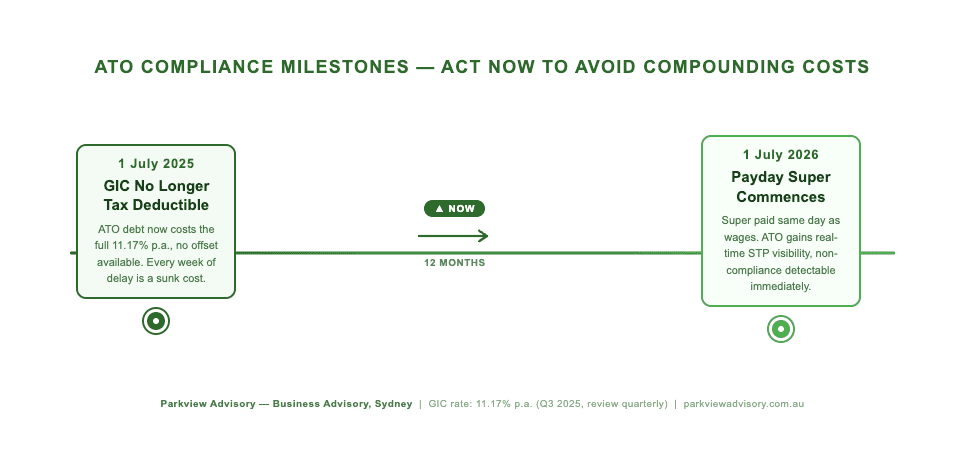
The first deadline has already passed. The second is approaching fast, and unlike the GIC change, Payday Super introduces a real-time enforcement mechanism that removes any margin for error.
Payday Super Adds a New Layer of ATO Enforcement
From 1 July 2026, Payday Super requires employers to pay superannuation guarantee contributions on the same day as salary and wages. The current quarterly cycle is being replaced entirely.
The enforcement implication is significant. STP data already tells the ATO exactly when you pay your employees. Once Payday Super takes effect, the ATO will have real-time visibility into whether super was paid on the correct day. Non-compliance will not be discovered months later during a quarterly reconciliation. It will be detectable immediately, and it will attract Superannuation Guarantee Charge (SGC) penalties and ATO enforcement action.
This is part of a broader pattern. The ATO is building real-time compliance infrastructure across payroll, super, and reporting. Audit-readiness is becoming an ongoing operational requirement, not something you prepare for once a year.
For detailed Payday Super guidance, including implementation timelines and system requirements, Parkview Advisory has published a dedicated guide for Sydney small business owners.
Record-Keeping That Actually Survives an Audit
If you want to know how to prepare for an ATO audit, start with the legal standard. The Tax Administration Act 1953 requires businesses to retain records for five years from when they are prepared, obtained, or the transaction is completed.
But there is a practical distinction between records that satisfy a review and records that survive a full audit.
A review typically involves the ATO requesting summary-level information and reasonable explanations. A full audit requires source documents: bank reconciliations, contracts, supplier invoices with Australian Business Numbers (ABNs), employee records, and BAS working papers. If your records are inadequate during an audit, the ATO can issue a default assessment based on its own calculations. You lose control of the outcome.
The ATO accepts digital records provided they are legible, complete, and backed up. Format matters less than substance. What determines your audit resilience is the quality of your finance function, not whether your records are stored in a filing cabinet or the cloud.
This is where clean, audit-ready bookkeeping pays for itself. A well-maintained system produces the source documents an auditor needs without anyone scrambling to reconstruct history. Parkview Advisory, a Sydney-based business advisory practice, builds exactly this kind of ongoing finance function for small and medium businesses.
What to Do When the ATO Contacts You
The ATO conducts three types of compliance activity, and your response strategy should differ for each. The table below summarises the key differences for the query ‘difference between ATO review and audit’:
| Type | How Conducted | Scope | What It Means for You |
|---|---|---|---|
| Review | Letter or phone requestfor specific information | Targeted and narrow | Least formal; respond promptlywith requested documents |
| Desk Audit | Conducted entirely bycorrespondence | Broader than a review;may cover multipleyears or issues | Carries more weight; have anadvisor managecorrespondence |
| Field Audit | ATO officer visits yourpremises to examinerecords directly | Most extensive; canexpand based onfindings | Most intensive andconsequential; have arepresentative present |
Under the Taxpayer’s Charter, you have the right to have a tax agent or legal representative present during any compliance activity. You have the right to request reasons for any ATO decision. And you have the right to object to an assessment within the statutory timeframe, generally 60 days for income tax.
The critical advantage in any of these scenarios is having an advisor who already knows your business. An advisor familiar with your numbers can respond faster, contextualise anomalies, and represent you with authority. The alternative is an accountant who only sees your affairs at tax time, trying to reconstruct your financial story under pressure. That is not a position of strength. Parkview Advisory provides ongoing advisory support for Sydney businesses facing ATO reviews, desk audits, and field audits.
Audit-Readiness Is a Business Practice, Not a Panic Response
If you have monthly reporting, regular strategic meetings with your advisor, and a finance function that reconciles as it goes, you are already audit-ready. No additional preparation required. No panic. No scrambling.
That is the difference between an advisory-led relationship and a transactional one. The accountant who only appears at tax time cannot protect you from an ATO review because they do not know your business well enough to explain your numbers. They cannot contextualise a benchmark outlier or walk an auditor through your commercial rationale.
Ongoing compliance built into the advisory relationship means your records are current, your lodgements are on time, and your numbers tell a coherent story. No GIC compounding while you try to locate source documents. No default assessments because your records were incomplete. Your finance function operates as an extension of your business, not a once-a-year afterthought.
See how ongoing ATO compliance advisory works with Parkview Advisory
Talk to Parkview Advisory in Sydney about staying audit-ready
Frequently Asked Questions About ATO Audits
What triggers an ATO audit for small business?
The most common triggers are data-matching discrepancies between bank feeds, BAS, and tax returns. Benchmark outliers, late lodgements, cash-intensive industry classification, and lifestyle-versus-income mismatches also increase your likelihood of being selected. The ATO cross-references STP, TPAR, bank data, and third-party sources to identify inconsistencies. The ATO also uses AI and machine learning to flag anomalies automatically, meaning selection is increasingly algorithm-driven rather than manually triggered.
How long does an ATO audit take?
It depends on the type and complexity. Reviews can be resolved in weeks. Desk audits typically take several weeks to a few months. Field audits can extend significantly if records are inadequate or the scope expands. The quality of your records and the responsiveness of your advisor are the two biggest factors in how quickly an audit concludes.
What records does the ATO require during an audit?
Source documents including bank statements, BAS working papers, contracts, supplier and sales invoices, and employee records. The Tax Administration Act 1953 requires five-year retention from when records are prepared, obtained, or the transaction is completed. If records are missing, the ATO can issue a default assessment based on its own calculations.
What is the ATO general interest charge?
The GIC is the charge applied to outstanding tax debts. The current rate is 11.17% per annum, compounding daily (Q3 2025; verify the current rate each quarter). From 1 July 2025, the GIC is no longer tax deductible, meaning the full cost now sits with the business with no offset. For a $50,000 debt, that compounds to approximately $5,735 over 12 months.
How do I prepare for an ATO audit?
Knowing how to prepare for an ATO audit comes down to three things: complete and current records, timely lodgements, and an advisor who knows your numbers before you receive any ATO correspondence. Parkview Advisory, a business advisory firm based in Sydney, specialises in helping small business owners build audit-ready finance functions that remove the risk of being caught unprepared.