

Introduction
Many SME owners suspect that a business advisory accountant is just the same as their regular accountant, but with a higher invoice. That suspicion is reasonable, especially when firms rebrand traditional compliance services as “advisory.” However, a genuine business advisory accountant offers much more than just lodging BAS returns and preparing tax filings. They play a crucial role in helping businesses make informed, strategic decisions for the future. This article will clarify what business advisory accounting truly involves and how it can help your business grow beyond its compliance obligations.
What is business advisory?
Business advisory is the practice of using financial data to guide forward-looking business decisions. It goes beyond compliance accounting to include strategic planning, cash flow forecasting, pricing analysis, and ongoing decision-making support, enabling businesses to make informed choices that drive growth.
Business advisory accounting means your accountant is involved in the decisions you make going forward, not just reporting on what already happened. Accounting is the foundation. Advisory is the layer that turns financial data into action. For a deeper look at what business advisory is as a service model, see our companion guide.
Is 'business advisory' just a marketing buzzword?
You have every right to be sceptical. Many SME owners suspect that “business advisory” means the same accountant, the same service, and a higher invoice. That suspicion is reasonable. A significant number of firms have simply relabeled their compliance work as advisory.
Your experience with accountants is probably transactional. They lodge the BAS (Business Activity Statement), prepare the tax return, and send the bill. That model works. But it has a ceiling.
According to Business Queensland, business advisers help identify and reach business goals and make decisions at key phases of the business lifecycle ATO - Business Activity Statements. That is fundamentally different from someone who reports on what has already happened.
By the end of this article, you will know exactly what a business advisory accountant does differently, what the deliverables look like, and whether it is relevant to your stage of business.
What a business advisory accountant actually does
Business advisory accounting means your accountant is involved in the decisions you make going forward, not just reporting on what already happened. Accounting is the foundation. Advisory is the layer that turns financial data into action.
Here is what that looks like in concrete terms:
- Monthly management reporting with written analysis. Not a Profit and Loss (P&L) statement emailed without context. A report that tells you what changed, why it changed, and what to consider next.
- Regular strategic meetings. Monthly or quarterly, structured around your goals. Not a catch-up at tax time.
- Cash flow forecasting and scenario planning. Modelling what happens to your cash position if you hire, invest, or lose a key client.
- Pricing and profitability analysis by service line or product, so you know where your margin actually sits.
- Decision-making support for hiring, investing, or expanding. Financial modelling that helps you weigh up the options before you commit.
Business Queensland notes that business advisers should help with strategic planning, financial management, and operational decisions beyond compliance requirements ASIC - For Business. That is the standard a genuine business advisory relationship should meet.
Business advisory services extend beyond traditional compliance tasks. They help businesses with strategic financial planning, operational decisions, and cash flow optimisation. Engaging a business advisory accountant can transform how you make decisions based on financial data.
Compliance still happens. BAS lodgements, tax returns, and year-end accounts. But compliance is the baseline, not the relationship. The relationship is built around the decisions you make, not the obligations you meet.
The difference between compliance accounting and advisory accounting
The simplest way to see the difference is through specific scenarios. To better understand how compliance accounting differs from advisory accounting, we've outlined a side-by-side comparison of key scenarios below.
| Scenario | Compliance Accounting | Advisory Accounting |
|---|---|---|
| Reporting | Sends year-end Profit & Loss (P&L) statement with no context. | Sends monthly management reports with written analysis and actionable insights. |
| Meetings | Meets once a year to review tax position. | Meets monthly or quarterly to discuss strategy, performance, and decisions. |
| Tax Planning | Look for tax deductions after the financial year ends. | Integrates tax planning into ongoing business decisions, ensuring the optimal structure before funds move. |
| Availability | Returns calls within a week. | Available same-day to discuss significant business decisions. |
The integration of accounting and business advisory allows businesses to not only stay compliant but also make strategic decisions that drive growth. While accounting covers basic financial reporting and compliance needs, business advisory services offer proactive support for forecasting, budgeting, and overall financial planning.
By placing the table here, you maximise its value in making the key differences between compliance and advisory accounting clear and easily digestible for readers.
- Reporting: A compliance accountant sends you a year-end P&L. A business advisory accountant sends you a monthly management report with written commentary explaining what the numbers mean for your next quarter.
- Meetings: A compliance accountant meets you once a year to review your tax position. An advisory accountant meets you monthly or quarterly to discuss strategy, performance, and upcoming decisions.
- Tax planning: A compliance accountant looks for deductions after the financial year ends. An advisory accountant integrates tax planning into your business decisions throughout the year, so the structure is right before the money moves.
- Availability: A compliance accountant returns your call within a week. An advisory accountant is available the same day when you are weighing up a significant decision.
This is not a criticism of compliance accounting. It is essential and the foundation every business needs. Advisory builds on top of it. Some businesses are at a stage where compliance is enough. Others have outgrown that model.
The distinction matters because different types of professional business advice serve different functions. Financial advisers, accountants, legal specialists, bankers, and insurance brokers all play a role. But your accountant is uniquely positioned to provide advisory services because they already hold your financial data. They can deliver a full finance function as an extension of your business, rather than piecemeal compliance where your BAS goes one place, your tax return goes another, and nobody connects the dots.
If you are evaluating the cost difference between these models, it helps to understand what accountants typically cost in Australia as a baseline before considering what advisory adds.
When does a business advisory accountant become essential?
There is a specific growth stage where advisory becomes critical. For businesses with revenues between $500K and $5M, small business advisory services become critical. At this stage, your financial decisions become more complex, and a business advisory accountant can help you manage cash flow, plan investments, and make informed decisions about growth.
You will recognise the pain points:
- Cash flow is unpredictable despite growing revenue.
- You are making hiring or investment decisions without financial modelling.
- Your accountant only contacts you at tax time.
- You do not know which products or services are actually profitable.
- You are unsure whether your pricing covers your true costs.
To help you assess whether it's time to consider a business advisory accountant, here's a quick self-assessment checklist.
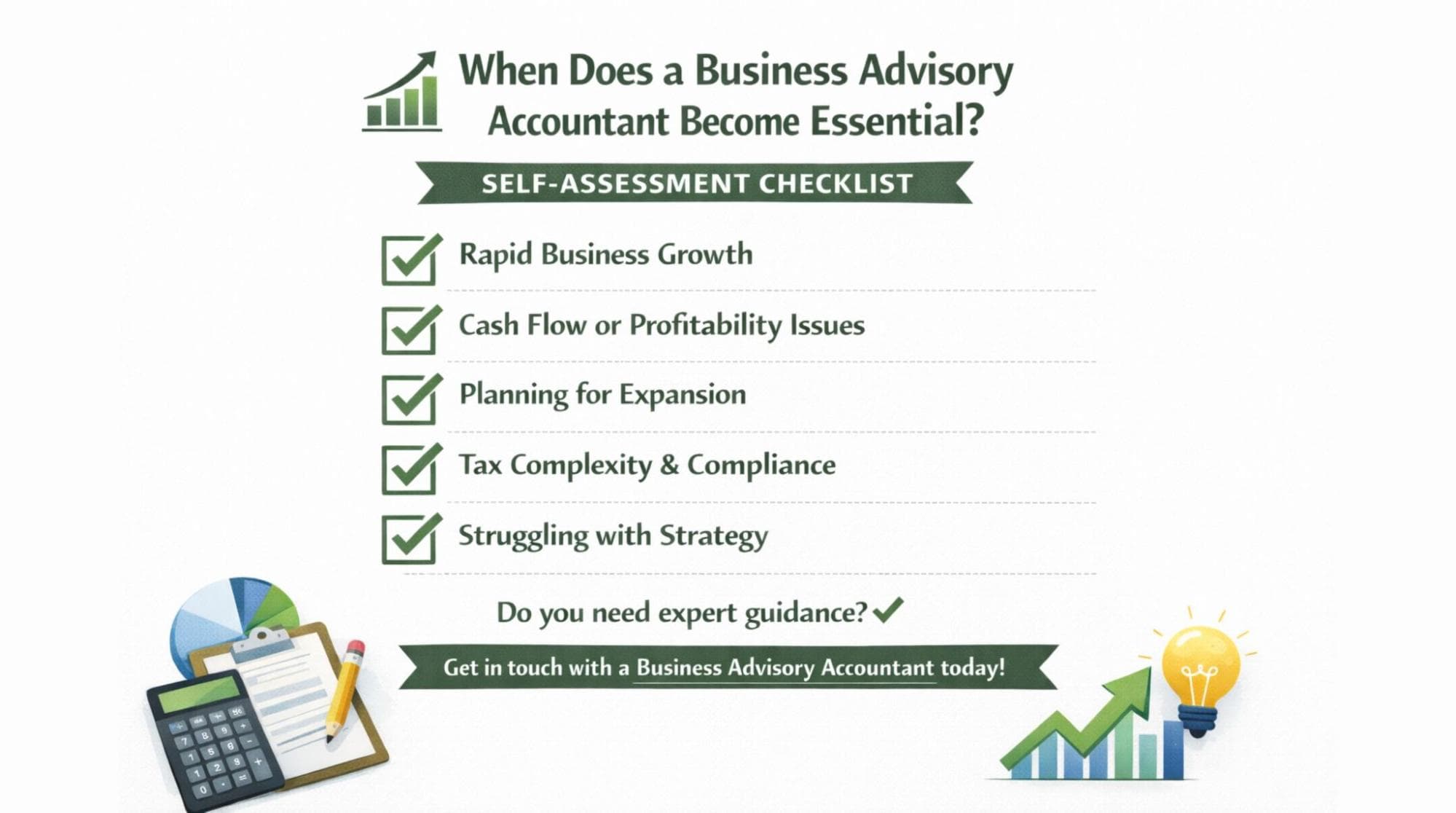
When choosing a business adviser, Business Queensland recommends considering their qualifications, experience, industry knowledge, and how they charge for services. These factors matter more at this stage because the wrong adviser costs you time and missed opportunities, not just fees.
For businesses that need CFO-level thinking without the CFO salary, the natural extension of advisory is a Virtual Chief Financial Officer (VCFO). A VCFO provides strategic financial leadership on a fractional basis, covering everything from board-level reporting to capital planning. If that model sounds relevant, you can explore what a Virtual CFO does and how it works.
How to tell if your accountant is genuinely advisory
Rather than a checklist, here are five honest questions to ask yourself or your accountant.
Do they send monthly reports with written analysis, or just numbers? A P&L without commentary is data, not insight. Advisory means someone has interpreted the numbers and told you what matters.
Do they schedule regular meetings to discuss strategy, or only contact you at tax time? The cadence of engagement is the clearest signal. Monthly or quarterly meetings focused on your goals are advisory in nature. An annual tax review is for compliance.
Can you call them when you are weighing up a significant decision? If you wouldn't think to consult your accountant before signing a lease or making a key hire, the relationship isn't advisory.
Do they proactively raise opportunities or risks, or only respond when asked? An advisory accountant notices trends in your data and brings them to you. They do not wait for you to ask the right question.
Do they understand your business model, your margins, and your growth plans? If your accountant could not explain how your business makes money, they are processing transactions, not advising you.
Some firms have rebranded compliance as advisory. Your scepticism is warranted. Genuine advisory is defined by the cadence of engagement, the depth of financial analysis, and the relationship's proactive nature. The ideal advisory relationship feels like an extension of your business, not an external vendor you hear from twice a year.
What to look for in a business advisory accountant
When evaluating advisory firms, three things matter most.
Do they lead with advisory, or lead with compliance and bolt advisory on? Firms that start from compliance and add advisory as an upsell tend to deliver a different experience from firms where advisory is the core offering. The structure of the engagement tells you which model you are getting.
Do they offer a monthly retainer model? A monthly retainer aligns incentives with ongoing value. Hourly billing for ad-hoc advice creates a disincentive to call, which is the opposite of what an advisory relationship should do.
Do they have a commercial understanding of your industry and growth stage? Technical accounting skill is necessary but not sufficient. Your advisory accountant needs to understand the commercial realities of running a business at your scale.
At Parkview, advisory leads and accounting are the enablers. The full finance function is delivered as an extension of the client's business, not as a series of piecemeal services. Monthly reporting, regular strategic meetings, and day-to-day availability are standard, not add-ons. This is advisory-led accounting, where compliance is handled while the focus remains on your decisions and growth.
The right business advisory accountant should feel like a strategic partner in your corner. Someone who understands your numbers and your ambitions. If that is what you have been missing, it is worth exploring what an advisory-led model looks like in practice.
Find out what advisory-led accounting looks like for your business.
Alex
Alex is the founder of Parkview Advisory, helping SME owners make better financial decisions through advisory-led accounting.